
Sole Trader NDIS Provider Registration: Complete 2025 Guide for Individuals
Can a sole trader register as an NDIS provider? The short answer is yes — and thousands of individual practitioners across Australia have done exactly that. Sole trader NDIS provider registration follows the same fundamental process as organisational registration, but with key differences in cost, documentation, and practical considerations. This guide answers every question sole traders have about registering as an NDIS provider in 2025. You will learn the exact requirements, step-by-step process, realistic costs, the pros and cons of registration versus starting unregistered, and how to decide which path is right for your individual situation.
What Is Sole Trader NDIS Provider Registration?
Sole trader NDIS provider registration is the process by which an individual operating their own business — under their own ABN — formally registers with the NDIS Quality and Safeguards Commission to deliver funded supports to NDIS participants. It gives a single practitioner or independent worker the same legal standing as a registered provider organisation, enabling them to work with all participant funding types including NDIA-managed participants.
Can a Sole Trader Actually Register as an NDIS Provider?
Yes — absolutely. The NDIS Quality and Safeguards Commission accepts applications from individuals operating as sole traders. There is no requirement to be incorporated as a company or to have multiple employees. Many independent support workers, allied health practitioners, and community care professionals deliver NDIS services successfully as registered sole traders.
However, it is important to understand that individual provider NDIS registration carries the same obligations and responsibilities as organisational registration. You must meet the same NDIS Practice Standards, hold the same insurances, complete worker screening, and undergo an audit. The scale is smaller, but the standards are identical.
Requirements for Sole Trader NDIS Registration
Before applying, you must ensure you meet all eligibility and compliance requirements. Meeting these requirements upfront saves significant time and avoids rejection or audit failure later.
Australian Business Number (ABN)
An ABN is the foundation of ABN NDIS registration for sole traders. You must hold a current, active ABN in your own name or trading name before applying. If you do not yet have an ABN, you can register for free through the Australian Business Register. Your ABN identifies you as a business entity and is required throughout the NDIS Commission Portal application process.
Your ABN must be registered for GST if your expected annual turnover exceeds $75,000. Even if your turnover is below this threshold, voluntary GST registration may be beneficial depending on your specific circumstances. Seek advice from a registered accountant before making this decision.
Public Liability and Professional Indemnity Insurance
Insurance is a mandatory requirement for all registered NDIS providers, including sole traders. You need both public liability insurance and professional indemnity insurance before your registration can be finalised. Public liability insurance covers injury or property damage claims arising from your work. Professional indemnity insurance protects against claims related to professional advice or errors in service delivery.
For a sole trader, combined annual insurance premiums typically range from $1,200 to $3,500. The exact cost depends on the types of supports you deliver, your estimated turnover, and the insurer. Higher-risk supports attract higher premiums. Compare policies from insurers who specialise in NDIS providers to ensure your coverage meets the Commission’s requirements.
NDIS Worker Screening Check
As a sole trader providing NDIS services, you must hold a valid NDIS Worker Screening Check — even if you are the only person delivering services. This check confirms you do not have any findings that would disqualify you from working with NDIS participants. The worker screening process involves a national police check plus checks against additional databases maintained by state and territory authorities.
Worker screening check fees range from $80 to $195, depending on your state or territory. The check is valid for five years, provided you maintain continuous employment in an NDIS role. Processing times vary, but typically take one to four weeks.
Compliance With NDIS Practice Standards
Sole trader NDIS registration requires full compliance with the relevant NDIS Practice Standards. These standards define the quality benchmarks your service delivery and governance must meet. The specific standards that apply depend on which registration groups you apply for. All providers — regardless of size — must meet the Core Module standards covering participant rights, provider governance, provision of supports, and the support environment.
Supplementary modules apply for higher-risk supports such as Specialist Behaviour Support, High Intensity Daily Personal Activities, and others. As a sole trader, your documentation and self-assessment must demonstrate how you personally meet each standard, rather than how an organisation does. Review the NDIS compliance checklist to ensure you have addressed all requirements before submitting your application.
PRODA Account
The registration application is submitted through the NDIS Commission Portal, which requires a PRODA (Provider Digital Access) account. PRODA is the Australian Government’s online identity verification system. You must set up your PRODA account and link it to your business entity before starting the application process. PRODA setup is free and typically takes one to two business days.
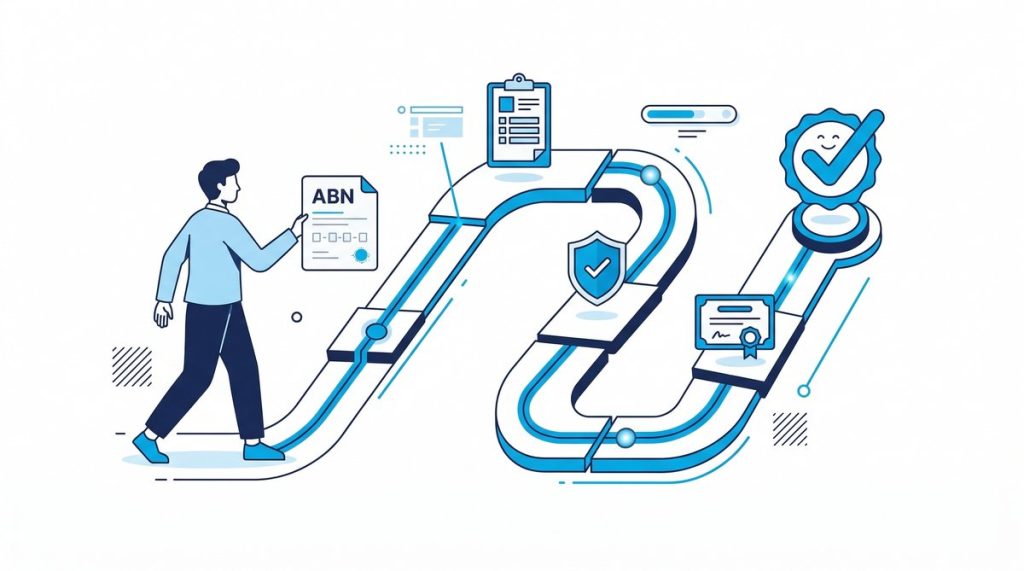
Step-by-Step: How Sole Trader NDIS Registration Works
The registration process for a sole trader follows the same steps as organisational registration, but the volume of documentation is generally smaller. Here is the complete process from preparation to approval.
Step 1: Establish Your ABN and Business Structure
Register or confirm your ABN through the Australian Business Register. Decide on your trading name and ensure your business details are current and accurate. Consider whether you need to register for GST at this stage. This foundational step makes all subsequent steps possible.
Step 2: Identify Your Registration Groups
Determine which registration groups align with the supports you want to deliver. Your choice of registration groups determines whether you need a verification audit or a certification audit — which is the most significant cost decision in the entire process. Lower-risk groups such as Household Tasks, Transport, or Assistive Products require only a verification audit. Higher-risk groups such as Personal Care, Specialist Behaviour Support, and SIL require a certification audit.
As a sole trader, starting with verification-only groups reduces your upfront audit cost significantly. You can add higher-risk registration groups later once your business is generating revenue. Review the registration checklist for a complete list of registration groups and their audit requirements.
Step 3: Develop Your Policies and Procedures
You must have documented policies and procedures that demonstrate how you will meet the NDIS Practice Standards for each of your registration groups. For a sole trader, this means creating personalised documents rather than organisational handbooks. Your policies must cover governance, risk management, complaint handling, incident management, privacy, and the specific standards for your registration groups.
Budget between $500 and $2,000 for a quality template package, or up to $8,000 if you engage a consultant. As a sole trader with limited time, a good template package is often the most cost-effective option. Ensure your service agreement is also prepared, as this is a Practice Standards requirement.
Step 4: Obtain Insurance and Worker Screening
Arrange your public liability and professional indemnity insurance. Obtain your NDIS Worker Screening Check. Both must be in place — or substantially advanced — before your audit proceeds. Your auditor will require evidence of insurance during the audit process.
Step 5: Create Your PRODA Account and Apply
Set up your PRODA account and access the NDIS Commission Portal. Complete the online application, including your self-assessment against the NDIS Practice Standards for each of your selected registration groups. The self-assessment requires you to rate your compliance and provide evidence for each standard. Submit your application and pay the $606 application fee.
Step 6: Engage an Approved Quality Auditor
After submitting your application, the Commission will notify you that you can engage an approved quality auditor. Obtain quotes from at least three auditors accredited for your registration groups. Select an auditor and schedule your audit. The auditor will review your documentation and, for certification audits, conduct an on-site assessment. Processing and scheduling typically takes four to 12 weeks from application submission.
Step 7: Complete the Audit and Await the Commission Decision
Work through the audit process with your chosen auditor. If any non-conformances are identified, you will need to address them and provide corrective action evidence. Once the auditor submits their report, the Commission makes a registration decision. This typically takes one to three weeks. Upon approval, you receive your Certificate of Registration, which specifies your authorised registration groups and registration period.
Sole Trader vs Organisation: Key Differences in the Registration Process
While the overall process is the same, there are meaningful practical differences between sole trader and organisational registration that you should understand before starting.
Governance Documentation
Organisations must demonstrate a governance structure including boards, management structures, and organisational policies. As a sole trader, your governance documentation is simpler — but you still need to demonstrate how you personally manage risk, make decisions, handle complaints, and maintain accountability. The NDIS Code of Conduct applies to you as an individual provider, not just to an organisation.
Audit Scale and Cost
Sole trader audits generally cost less than organisational audits because there is only one site, one practitioner, and a smaller volume of records to review. A sole trader verification audit typically costs $900 to $2,000, compared to $1,500 to $3,000 for a small organisation. A sole trader certification audit typically costs $2,500 to $6,000, compared to $5,000 to $15,000 for organisations with multiple staff and sites.
Worker Screening Obligations
As a sole trader, worker screening applies only to you. Organisations must manage screening for every worker and key personnel member, which multiplies the cost and administrative burden. This is one of the practical advantages of sole trader registration.
Continuity of Service
One important consideration for sole traders is continuity of service. If you become ill, take leave, or are otherwise unable to deliver services, your participants may be left without support. Organisations can cover absences with other staff. As a sole trader, you need to plan how you will manage participant continuity and communicate clearly with participants about your availability policies.
Costs for Sole Trader NDIS Provider Registration in 2025
Understanding the full cost of sole trader NDIS registration helps you plan your finances and timeline accurately. Here is a detailed cost breakdown for sole traders in 2025:
| Cost Item | Low Estimate | High Estimate |
|---|---|---|
| Application fee (individual) | $606 | $606 |
| Verification audit | $900 | $2,000 |
| Certification audit (if applicable) | $2,500 | $6,000 |
| Public liability insurance (annual) | $600 | $1,500 |
| Professional indemnity insurance (annual) | $800 | $2,000 |
| Worker screening check | $80 | $195 |
| Policy and procedure templates | $500 | $2,000 |
| Software (billing, records) | $1,000 | $3,000 |
For a sole trader seeking a verification audit, the total first-year cost is approximately $3,000 to $7,500. For a sole trader needing a certification audit, the total first-year cost ranges from approximately $6,000 to $11,800. These estimates align with current market data and Commission guidance for individual providers.
Explore NDIS billing software options designed for sole traders — lightweight, affordable tools that help you manage claims and finances without enterprise-level costs. Good NDIS software also streamlines your compliance documentation requirements from day one.
Should You Start Unregistered First?
One of the most practical questions for sole traders is whether to begin delivering NDIS services as an unregistered provider before investing in full registration. This is a legitimate and increasingly common pathway.
What Unregistered Providers Can and Cannot Do
Unregistered providers can deliver NDIS services to participants who are self-managed or plan-managed. They cannot deliver services to NDIA-managed participants, and they cannot deliver supports that are categorised as requiring registration — regardless of the participant’s plan management type. Some supports, such as Specialist Behaviour Support and SIL, always require a registered provider.
This means starting unregistered is only viable if you are targeting self-managed or plan-managed participants and your chosen supports do not mandate registration. You should also comply with the NDIS Code of Conduct as an unregistered provider — it applies to all NDIS service providers, registered or not.
Advantages of Starting Unregistered
Starting as an unregistered provider offers several practical benefits for sole traders:
- You can begin earning revenue immediately without waiting three to six months for registration
- You gain practical experience delivering NDIS services before investing in full registration
- You generate income to fund your registration costs
- You can build a client base and referral network while preparing for registration
- You have time to develop robust policies and procedures without time pressure
Risks and Limitations of Staying Unregistered
There are also meaningful risks to remaining unregistered long-term:
- You miss out on the large NDIA-managed participant market
- Some plan managers and support coordinators preferentially refer to registered providers
- You have no formal audit assurance to offer participants about your service quality
- Some supports that are growing in demand — such as personal care and behaviour support — require registration
- Building a sustainable NDIS business long-term typically requires registration
For most sole traders, the practical advice is to start unregistered, build a client base and revenue, then invest in registration once your business can absorb the cost. Check the current NDIS guidance on registration requirements to confirm whether your specific supports require registration.
Pros and Cons of Sole Trader NDIS Registration
Registration is a significant investment. Understanding both the benefits and the drawbacks helps you make an informed decision at the right time for your business.
Advantages of Registering as a Sole Trader
- Access to all participant types — including NDIA-managed participants, the largest segment
- Credibility and trust — registration signals quality assurance to participants, families, and referrers
- Broader service scope — enables delivery of higher-risk, higher-value supports
- Preference in referrals — many support coordinators and plan managers prioritise registered providers
- Stronger governance — the registration process forces you to build robust policies and procedures
Disadvantages of Sole Trader Registration
- Upfront cost — first-year costs of $3,000 to $11,800 are significant for a new business
- Time investment — documentation preparation, audit preparation, and the process itself take 60+ hours
- Ongoing compliance burden — maintaining compliance with Practice Standards requires continuous effort
- Renewal every three years — registration is not a one-time investment; audits and fees recur at renewal
- No coverage for absence — unlike organisations, sole traders cannot easily cover participant continuity during illness or leave
People Also Ask About Sole Trader NDIS Registration
Do I need an ABN to register as an NDIS provider as a sole trader?
Yes. An ABN is required for all NDIS provider registration applications. You cannot apply through the NDIS Commission Portal without a valid ABN. If you do not yet have an ABN, register for one free through the Australian Business Register before starting your application. ABN registration typically takes one to two business days.
Can I register as an NDIS provider under my own name without a company?
Yes. Sole traders can register under their own name or a registered trading name without incorporating as a company. The NDIS Commission accepts sole trader registrations. You will use your individual ABN for the application. A company structure is not required, though some accountants recommend it for liability protection as your business grows.
How long does sole trader NDIS registration take?
The total process typically takes three to six months end-to-end. The preparation phase takes one to two weeks, application submission takes approximately one week, the audit and review phase takes four to 12 weeks, and the Commission’s decision takes one to three weeks. Overall timelines depend on how well-prepared your documentation is and how quickly your chosen auditor can schedule your audit. It is worth noting that only 9% of eligibility decisions currently meet the 21-day target.
How Inficurex Helps Sole Traders Register and Operate as NDIS Providers
Inficurex is purpose-built for NDIS providers — including sole traders who are managing every aspect of their business independently. The platform simplifies NDIS billing, automates claim submissions, tracks participant service agreements, and manages incident reporting, all from a single dashboard. For a sole trader, this means spending less time on administration and more time delivering quality supports to participants.
Inficurex also makes ongoing compliance easier by providing tools aligned with NDIS Practice Standards and Commission reporting requirements. Whether you are preparing for your first audit, managing day-to-day claims, or planning for registration renewal, Inficurex grows with you. See how Inficurex can support your sole trader NDIS business at inficurex.com.
Frequently Asked Questions: Sole Trader NDIS Provider Registration
What insurance do I need as a sole trader NDIS provider?
You need both public liability insurance and professional indemnity insurance. Public liability covers injury or damage claims, while professional indemnity covers claims related to your professional advice or service errors. Combined annual premiums for sole traders typically range from $1,200 to $3,500. Both policies must be in place before your registration can be finalised.
Can a sole trader deliver all NDIS supports?
A sole trader can apply for any registration group that the Commission permits for individual providers. However, some high-risk registration groups — particularly those involving complex needs — may carry practical limitations for sole traders in terms of continuity of service. Confirm which registration groups align with your qualifications and capacity before applying.
Do I need qualifications to register as a sole trader NDIS provider?
Qualification requirements depend on the registration groups you apply for. Some supports — particularly allied health, behaviour support, and early childhood — require specific professional qualifications or AHPRA registration. Other support types may have no formal qualification requirement but do require demonstrated competency. Check the specific requirements for your target registration groups through the NDIS Commission website.
Is the NDIS registration process different for sole traders compared to companies?
The steps are the same, but the scale differs. Sole traders complete the same application, self-assessment, and audit process. However, your documentation focuses on individual governance rather than organisational structures. Audit costs are generally lower for sole traders due to smaller scale. The application fee is also lower — $606 for individuals versus $1,212 for organisations.
What happens to my NDIS registration if I take on employees?
If you engage employees, you will need to obtain NDIS Worker Screening Checks for each worker in a risk-assessed role. You may also need to review and update your policies to cover employee management obligations. The SCHADS Award under the Fair Work Act applies to disability support workers. Your registration itself does not change, but your compliance obligations expand with each new worker.
Can I subcontract work to other sole traders once I am registered?
Yes, registered providers can engage subcontractors. However, as the registered provider, you remain responsible for ensuring subcontractors comply with the NDIS Code of Conduct and hold valid worker screening checks. You should have written subcontracting agreements in place that clearly outline these obligations. Review the NDIS service agreement template guidance for relevant documentation considerations.
How do I manage NDIS billing as a sole trader?
Registered sole traders submit claims directly through the NDIS myplace Provider Portal or through NDIS-compatible billing software. Claims must align with the current NDIS Price Guide and your participant’s approved plan. Using dedicated NDIS billing software reduces errors and streamlines the claiming process, especially when managing multiple participants.
What is the difference between sole trader registration and plan management?
Sole trader NDIS registration refers to registering as a provider who delivers support services directly to NDIS participants. Plan management is a separate NDIS support category where a registered provider helps participants manage their NDIS funding and pay invoices. A sole trader can register as a direct support provider, a plan manager, or both — depending on their qualifications and business model. Review the NDIS plan management guide for more detail on that specific registration category.