
NDIS Provider Registration: Complete Step-by-Step Guide 2025-26
NDIS provider registration unlocks access to agency-managed participants, government contracts, and the full range of funded support delivery. However, the process is more complex than many new providers anticipate. Furthermore, documentation preparation alone can require 60 or more hours of work. As a result, understanding every stage before you begin dramatically improves your chance of a smooth application. This guide covers the complete registration steps 2025-26 — from setting up your PRODA account through to receiving your certificate of registration — with a realistic timeline and cost breakdown for each stage.
Whether you are a sole trader, a small allied health practice, or a growing support organisation, this guide provides the information you need to navigate the provider registration pathway confidently.
For a condensed compliance reference to use alongside this guide, see our NDIS provider registration checklist 2025.
What Is NDIS Provider Registration?
NDIS provider registration is the formal process through which the NDIS Quality and Safeguards Commission approves an organisation or individual to deliver specified NDIS supports or services. Registered providers are listed on the official NDIS provider finder and are subject to ongoing compliance obligations including audits and Code of Conduct requirements. Registration is mandatory for providers serving agency-managed participants and for delivering certain regulated support types.
Do You Need to Register?
Not all NDIS providers are required to register. Unregistered providers can deliver services to self-managed and plan-managed participants. However, registration opens access to the full market of agency-managed participants, who represent approximately 50% of all NDIS participants. Furthermore, some support types — including Supported Independent Living, behaviour support, and specialist disability accommodation — legally require registration regardless of how the participant manages their funds. You can learn more about the NDIS provider framework on the NDIS website’s provider hub.
Therefore, understanding whether your target market and support types require registration is the first strategic decision in the provider registration pathway.
Overview of the Registration Steps 2025
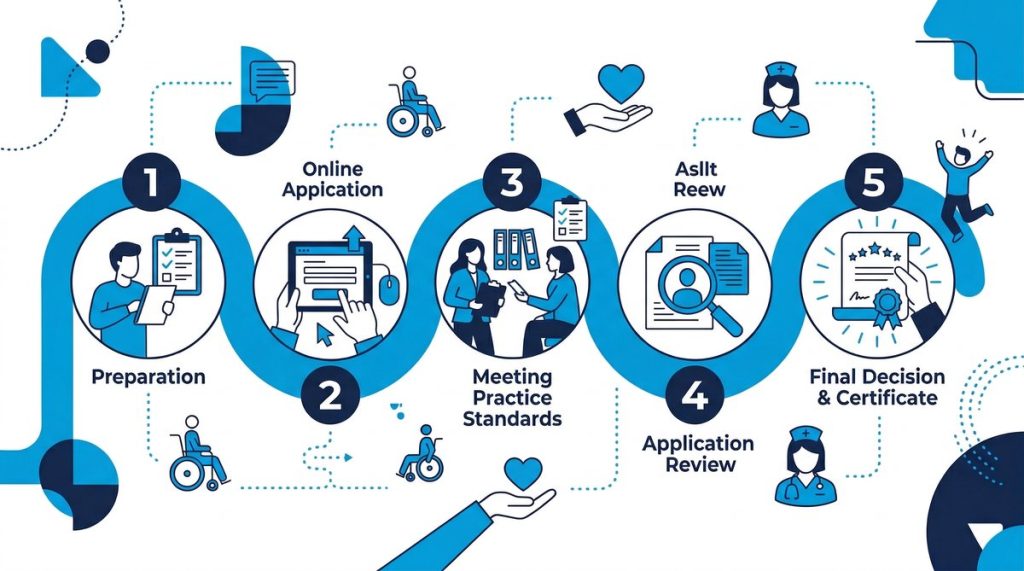
How to register as an NDIS provider involves six distinct stages. Each has its own requirements, timeframe, and common pitfalls. The overall process typically takes 6 to 18 weeks from application submission, with preparation potentially adding several additional weeks.
At a high level, the stages are:
- Preparation: Business planning and documentation development
- Create a PRODA account and access the Commission Portal
- Submit your application and complete the self-assessment
- Select your audit pathway and engage an approved auditor
- Complete the audit process
- Commission review and registration decision
Step 1: Preparation — Business Planning and Documentation
The preparation stage is the most time-intensive part of the registration process. Furthermore, it is the stage most often underestimated by new providers. Consequently, poor preparation is the leading cause of audit failures and delayed registrations.
Create Your Business Plan
Before submitting any application, you need a clear business plan that describes your service model, target participant cohort, staffing approach, and governance structure. The business plan should address financial viability, insurance coverage, and how you will meet the NDIS Practice Standards relevant to your registration groups.
Moreover, your business plan should specify which NDIS registration groups you are applying for. This selection directly determines your audit pathway and associated costs. Therefore, strategic selection of registration groups is a significant decision.
Download and Study the Provider Information Pack
The NDIS Commission provides a Provider Information Pack on its website. This pack contains detailed guidance on the NDIS Practice Standards, registration groups, and the application process. Furthermore, it includes the self-assessment tool you will complete during your application.
Consequently, reading the Provider Information Pack thoroughly before starting your application will save significant time and reduce errors. In addition, it will help you understand what policies and procedures you need to develop.
Develop Your Policies and Procedures
Every NDIS registered provider must have documented policies and procedures that demonstrate compliance with the NDIS Practice Standards. For most providers, this is the most labour-intensive preparation task. Moreover, generic templates downloaded from the internet frequently fail to meet the Commission’s expectations.
At a minimum, your policy suite should cover:
- Rights and responsibilities of participants
- Complaints and feedback management
- Incident management and mandatory reporting
- Worker screening and human resources
- Risk management and governance
- Safe delivery of supports and service environments
- Privacy and information management
For a detailed overview of what the Standards require, see our NDIS Practice Standards guide.
Organise Your Insurance
Before submitting your application, you must have appropriate insurance in place. This includes public liability insurance ($20 million cover is standard) and professional indemnity insurance where applicable. Furthermore, sole traders and small organisations should compare quotes from multiple insurers, as premiums vary significantly.
Insurance costs typically range from $600 to $1,500 per year for public liability and $800 to $2,000 per year for professional indemnity.
Step 2: Create a PRODA Account and Access the Commission Portal
PRODA (Provider Digital Access) is the Australian Government’s identity verification platform. You need a PRODA account to access the NDIS Commission Portal where applications are submitted. Furthermore, all ongoing compliance activities — including incident reporting and registration renewals — are managed through the Commission Portal.
Setting Up PRODA
Go to the Services Australia PRODA page to create your account. You will need to verify your identity using government-issued documents. Moreover, organisations must also complete the linking process to connect individual accounts to the entity that will hold the registration.
The PRODA setup process typically takes one to three business days for identity verification. Therefore, do not leave this step until after your policies are ready — set it up in parallel with your documentation development.
Accessing the Commission Portal
Once your PRODA account is active, you can log in to the NDIS Commission Portal. The portal provides guided navigation through the application process. Furthermore, the portal saves your progress, so you can complete the application in multiple sessions.
Step 3: Complete Your Application and Self-Assessment
The application itself has several sections that must all be completed accurately. Furthermore, the self-assessment component requires you to evaluate your current practices against each NDIS Practice Standard relevant to your registration groups.
Registration Groups Selection
During the application, you select the NDIS registration groups that cover the supports you intend to deliver. This is a critical decision because your registration groups determine your audit type, your audit costs, and the Practice Standards you must meet.
Lower-risk registration groups include transport, household tasks, home modifications, and assistive products. Consequently, these groups require only a verification audit, which is faster and cheaper. Higher-risk groups — such as Supported Independent Living, behaviour support, personal care, early childhood, and SDA — require a more intensive certification audit.
The Self-Assessment
The self-assessment is a structured review of your policies, procedures, and practices against each applicable NDIS Practice Standard. Furthermore, it requires you to provide evidence of how you meet each requirement. As a result, the quality of your self-assessment directly reflects the quality of your preparation work.
Completing the self-assessment typically takes 10 to 30 hours depending on the number of registration groups applied for. Moreover, it should be treated as a genuine assessment rather than a checkbox exercise, because auditors will scrutinise the self-assessment during the audit stage.
Key Personnel Disclosure
You must disclose all key personnel of the organisation, who will be subject to a suitability assessment by the Commission. Furthermore, key personnel must not be the subject of unresolved criminal history, bankruptcy, or prior adverse Commission decisions. Consequently, any issues with key personnel should be identified and addressed before application.
Step 4: Choose Your Audit Pathway
The audit is the most significant step in the how to register NDIS provider process. Your audit pathway depends entirely on your registration groups.
Verification Audit
A verification audit applies to lower-risk registration groups. It is conducted by an NDIS-approved quality auditor and involves a review of documentation and evidence against a defined checklist. Moreover, verification audits typically do not require site visits or interviews unless the auditor has specific concerns. Consequently, they are faster and less expensive than certification audits.
Verification audit costs range from approximately $900 to $3,000 depending on the scope and the auditing organisation selected.
Certification Audit
A certification audit applies to higher-risk registration groups. It involves a comprehensive assessment of your organisation’s systems, policies, staff competencies, and practices. Furthermore, certification audits include document reviews, staff interviews, participant interviews, and typically include one or more site visits.
Certification audit costs range from approximately $3,000 to $15,000 or more, depending on the size of your organisation, the number of registration groups, and the auditing organisation’s pricing. In addition, mid-term surveillance audits are required at approximately 18 months for certification pathway providers, at an additional cost of $1,500 to $5,000.
Selecting an Approved Quality Auditor
You must select an auditor from the Commission’s list of approved quality auditors. Furthermore, you should obtain quotes from multiple auditors before selecting one, as prices vary considerably. Moreover, the auditor’s experience with your support type and registration groups is an important selection criterion.
For guidance on maintaining compliance standards after registration, see our NDIS compliance checklist.
Step 5: The Audit Process
Once you engage an auditor, the audit itself proceeds through defined stages. Understanding each stage helps you prepare effectively and respond to findings efficiently.
Stage 1: Document Review
The auditor reviews your policies, procedures, and evidence documentation against the applicable NDIS Practice Standards. Consequently, the quality and completeness of your documentation directly affects the audit outcome. Furthermore, auditors look for evidence that documents are actively implemented, not merely filed.
Stage 2: Site Visit and Interviews (Certification Audit)
For certification audits, the auditor conducts a site visit and interviews staff and participants. In addition, they may review a sample of participant files, staff records, and incident reports. Therefore, your team must be familiar with your policies and procedures before the site visit.
Moreover, participant interviews are conducted independently and confidentially. As a result, preparing participants with information about the audit process — without coaching their responses — is appropriate and helpful.
Stage 3: Audit Report and Findings
The auditor produces a formal report that identifies conformities, non-conformities, and recommendations. Furthermore, non-conformities must be remediated before registration can proceed. Consequently, minor non-conformities may be corrected quickly, but major non-conformities may require substantial additional work.
Therefore, providers should treat non-conformities as genuine improvement opportunities rather than merely as compliance failures. In addition, the auditor’s report provides valuable guidance for building a stronger compliance framework going forward.
Step 6: Commission Review and Registration Decision
After the audit is complete, the auditor submits their report to the NDIS Commission. The Commission then reviews the application, the audit report, and any additional information before making a registration decision.
Commission Decision Timeframes
The Commission aims to make eligibility decisions within 21 days of receiving a complete application. However, in practice, only approximately 9% of eligibility decisions are made within this target timeframe. Furthermore, complex applications, incomplete documentation, or applications requiring further information can take significantly longer.
As a result, providers should not commit to service delivery start dates that depend on registration approval until a decision has actually been received.
Receiving Your Certificate of Registration
If approved, the Commission issues a certificate of registration. This document specifies your authorised registration groups, the duration of registration, and any conditions attached. Furthermore, registration is granted for a period of three years, after which renewal is required.
In addition, your organisation will be listed on the NDIS Provider Finder, making you visible to participants and their plan managers.
NDIS Provider Registration Timeline 2025-26
The realistic end-to-end timeline for NDIS provider registration in 2025-26 breaks down as follows:
- Preparation (policies, documentation, PRODA): 1–4 weeks
- Application submission and self-assessment: 1–2 weeks
- Audit scheduling and preparation: 1–4 weeks
- Audit process and report: 2–8 weeks
- Commission review and decision: 1–6 weeks
- Total from preparation to approval: 6–18 weeks (or 3–6 months for complex applications)
Therefore, providers planning to start NDIS service delivery should begin their registration process at least four months before their intended start date. Furthermore, sole traders and organisations applying for higher-risk registration groups should allow the full six months.
For detailed information on ongoing compliance obligations after registration, see our NDIS Code of Conduct guide.
NDIS Provider Registration Costs 2025-26
Understanding the full cost of registration steps 2025-26 helps you budget accurately and avoid unexpected expenses.
Application Fees
The NDIS Commission does not charge a standard application processing fee in most cases. However, some sources indicate fees of $606 for individuals and $1,212 for organisations in certain circumstances. Therefore, verify current fee structures directly with the Commission before submitting your application.
Audit Costs
Audit costs are paid directly to the approved quality auditor and represent the largest single registration expense:
- Verification audit: $900 – $3,000
- Certification audit: $3,000 – $15,000+
- Mid-term surveillance audit (certification pathway): $1,500 – $5,000
Additional Pre-Registration Costs
Beyond audit fees, providers should budget for the following:
- Policy and procedure development: $500 – $8,000 (depending on whether you develop internally or engage a consultant)
- Insurance (public liability + professional indemnity): $1,400 – $3,500 per year
- Worker screening checks: $80 – $195 per staff member
- NDIS provider software: $1,000 – $5,000 per year
Total First-Year Cost Estimates
Total first-year costs typically range from $3,000 to $11,800 for sole traders using the verification pathway, and from $11,000 to $19,000 for small organisations with two to five staff on the certification pathway. Furthermore, ongoing annual costs for insurance, software, and compliance activities should be included in your financial planning.
For information on NDIS software options that reduce ongoing compliance costs, see our guide to NDIS software for providers.
Sole Traders and NDIS Registration
Sole traders can register as NDIS providers. The provider registration pathway is the same as for organisations, with some practical differences worth noting.
As a sole trader, you will need an ABN (Australian Business Number) before applying. Furthermore, you must hold appropriate insurance in your own name. In addition, you will need to complete a worker screening check for yourself.
Sole traders typically apply for lower-risk registration groups, making the verification audit pathway appropriate and more affordable. Moreover, sole traders should consider whether starting as an unregistered provider serving self-managed and plan-managed participants first — while building their documentation and compliance framework — is a viable transitional approach.
What Happens After Registration Approval
Receiving your certificate of registration is the beginning of your ongoing compliance journey, not the end of it. Registered NDIS providers have continuing obligations that must be maintained throughout the three-year registration period.
Ongoing Compliance Obligations
After registration, you must maintain compliance with the NDIS Code of Conduct for all workers, notify the Commission of certain changes to your organisation, maintain valid worker screening checks for all relevant workers, report reportable incidents within prescribed timeframes, and cooperate with any Commission investigations or audits.
See our NDIS worker screening guide for detailed guidance on maintaining screening compliance after registration.
Service Agreements and Participant Onboarding
Once registered, you must use compliant service agreements with every participant before commencing funded supports. Furthermore, your service agreements must meet NDIS requirements for content and participant rights. As a result, having template agreements ready before your first participants enroll is essential.
Use our NDIS service agreement template as a starting point for your participant contracts.
Mid-Term Surveillance and Registration Renewal
Providers on the certification pathway must undergo a mid-term surveillance audit at approximately 18 months after initial registration. Moreover, registration renewal is required every three years, involving another full audit. Therefore, compliance should be treated as an ongoing program rather than a periodic event.
People Also Ask
How Long Does NDIS Provider Registration Take in 2025?
The registration steps 2025 timeline runs from 6 to 18 weeks from application submission to approval, with preparation potentially adding several additional weeks. Only approximately 9% of Commission eligibility decisions are made within the 21-day target timeframe. Furthermore, incomplete applications or complex registration group selections can extend the process significantly. Therefore, providers should plan for a minimum of three to six months from beginning preparation to receiving their certificate.
Can You Work as an NDIS Provider Without Registration?
Yes, in many cases. Unregistered providers can deliver supports to self-managed and plan-managed participants. However, they cannot serve agency-managed participants and cannot deliver certain regulated support types that legally require registration. Furthermore, unregistered providers are still subject to the NDIS Code of Conduct. As a result, unregistered status is not a way to avoid compliance obligations — it simply means a different market and less regulatory oversight.
What Are the Main Reasons NDIS Registration Applications Are Rejected?
Common rejection reasons include incomplete or inadequate policy documentation, failure to meet Practice Standards in the self-assessment, key personnel suitability concerns, and major non-conformities identified during the audit that are not adequately remediated. Furthermore, applications that include unrealistic self-assessments — claiming conformity without evidence — are frequently challenged during audit. Therefore, thorough preparation and honest self-assessment are the best investments you can make.
How Inficurex Supports the NDIS Provider Registration Journey
Navigating NDIS provider registration is significantly easier with the right tools in place from day one. Inficurex is purpose-built NDIS provider software designed to support the entire registration journey and ongoing compliance lifecycle. Furthermore, it provides incident management, progress notes, service agreement management, billing, and worker screening tracking in a single integrated platform.
Providers using Inficurex from the start of their registration process can build their compliance infrastructure in parallel with the application process. Moreover, the platform’s audit trail and documentation features directly support evidence gathering for self-assessments and audits. As a result, your auditor will have clear, organised evidence of your compliance systems rather than manually assembled folders of disconnected documents.
In addition, Inficurex grows with your organisation as you add participants, workers, and registration groups. Consequently, the investment made at registration supports your compliance for the full three-year registration period and beyond. See how Inficurex simplifies NDIS provider registration and compliance.
Frequently Asked Questions
Do I need to have clients before I can register as an NDIS provider?
No. You do not need existing participants to apply for NDIS registration. Furthermore, having participants before registration is actually not possible for agency-managed participant services, since you cannot lawfully deliver registered supports until your certificate is issued. Therefore, prepare and register first, then begin marketing to participants.
Can I register for multiple registration groups at once?
Yes. You can apply for multiple registration groups in a single application. However, each registration group must be addressed in your self-assessment and will be assessed in the audit. Moreover, adding higher-risk groups increases your audit scope and cost. Consequently, some providers start with lower-risk groups and add others over time as their capacity grows.
What is the difference between a verification audit and a certification audit?
A verification audit is for lower-risk registration groups and involves a document review without a site visit. A certification audit is for higher-risk groups and includes document review, staff interviews, participant interviews, and site visits. Furthermore, certification audits also require a mid-term surveillance audit at 18 months. As a result, certification audits are significantly more expensive and time-consuming.
How often do I need to renew NDIS provider registration?
NDIS registration is granted for a period of three years. Therefore, you must apply for renewal before your registration expires. Furthermore, renewal involves another audit and self-assessment. Consequently, providers should begin renewal preparations at least six months before their registration expires to avoid a gap in registration status.
What happens if I need to change my registration groups after approval?
You can apply to add or remove registration groups after initial registration. Adding higher-risk groups will require an additional audit for those new groups. Furthermore, the Commission must approve any changes before you begin delivering the new support types. Therefore, plan your registration group strategy carefully at the outset to minimise costly additions later.
Can a foreign national own or operate an NDIS registered provider?
Yes, foreign nationals can own or operate NDIS providers in Australia, provided they hold appropriate visas and meet all standard registration requirements. However, key personnel suitability assessments apply equally to foreign nationals and may involve additional verification steps. Furthermore, legal and tax advice specific to foreign ownership structures is advisable before proceeding.
Is NDIS registration different from DVA or Medicare provider registration?
Yes. NDIS registration is a completely separate process administered by the NDIS Commission. It is unrelated to Medicare provider registration (administered by Services Australia) or DVA provider approval. Moreover, holding one type of provider registration does not confer or accelerate approval for others. Therefore, if you plan to work across multiple funding streams, you must manage each registration independently.