
How to Report a Code of Conduct Breach to the NDIS Commission
Reporting an NDIS code of conduct breach protects participants and strengthens the entire disability support system. This guide walks you through every step — from identifying a breach to understanding what happens after you submit your complaint.
The NDIS Code of Conduct sets clear behavioural standards for every registered NDIS provider and worker in Australia. When those standards are breached, reporting that breach to the NDIS Quality and Safeguards Commission is the most direct way to trigger accountability.
Yet many people hesitate. They are unsure whether their situation counts as a breach, who is allowed to report, or what the process involves. This guide answers all of those questions in plain language.
Understanding the full scope of the NDIS Code of Conduct helps you identify when a breach has occurred. Once you recognise the issue, reporting it is a straightforward process.
What Is the NDIS Code of Conduct?
The NDIS Code of Conduct is a set of seven legally binding obligations that apply to all registered NDIS providers and their workers. It is established under the NDIS (Provider Registration and Practice Standards) Rules and enforced by the NDIS Commission.
The seven obligations require providers and workers to:
- Act with respect for individual rights to freedom of expression, self-determination, and decision-making
- Respect the privacy of participants
- Provide supports and services safely and competently, with care and skill
- Act with integrity, honesty, and transparency
- Promptly take steps to raise and act on concerns about matters that might affect participant quality and safety
- Take all reasonable steps to prevent and respond to all forms of violence against, exploitation, neglect, and abuse of participants
- Take all reasonable steps to prevent and respond to sexual misconduct
A breach occurs when a provider or worker fails to meet any of these obligations. Breaches range from isolated incidents to serious, ongoing patterns of harm. Regardless of severity, reporting an NDIS code of conduct breach is important.
Who Can Report a Code of Conduct Breach?
Anyone can report a concern to the NDIS Commission. There is no restriction on who can lodge a complaint or raise a concern. The Commission encourages reporting from a wide range of people.
NDIS Participants
Participants have the strongest standing to report a breach. If a provider or worker has treated you in a way that violates the Code, you can report that experience directly. You do not need a legal representative or advocate to do so.
Family Members and Carers
Family members, carers, and nominated representatives can report on behalf of a participant. This is especially important when a participant faces barriers to self-advocacy — for example, due to communication needs or the influence of an abusive provider.
NDIS Workers
Workers who witness or become aware of a breach by a colleague or their employer can report to the Commission. The NDIS Act includes protections for people who raise concerns in good faith. Reporting does not have to mean turning against your employer — it means upholding participant safety.
Members of the Public
Neighbours, community members, and other bystanders who observe potential breaches can also make a report. The Commission takes public concerns seriously and will assess each one on its merits. Reporting provider breach behaviour as a member of the public is a legitimate and valued part of the NDIS safeguarding system.
For workers who suspect a colleague has engaged in misconduct, reviewing your obligations under the NDIS Worker Screening framework is also valuable.
Step-by-Step Reporting Process
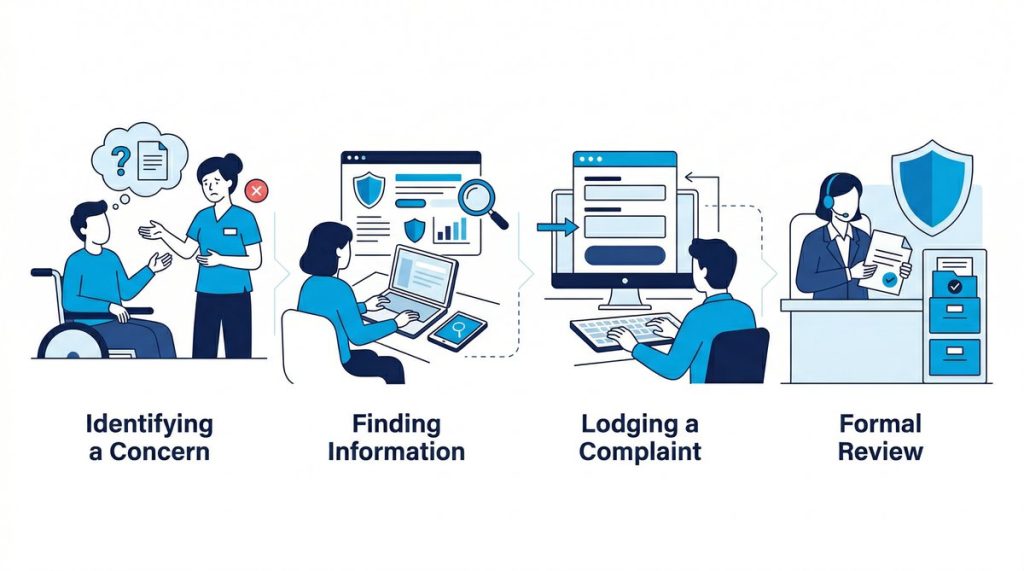
Reporting an NDIS code of conduct breach follows a clear sequence. Working through each step ensures your report is complete and gives the Commission the best chance of taking effective action.
1 Identify the breach clearly
Determine which of the seven Code obligations has been violated. Ask yourself: did the provider or worker fail to act with respect, honesty, care, or safety? Was the participant exposed to harm or the risk of harm? The more precisely you can name the obligation breached, the stronger your report will be.
2 Document what happened
Write down the details while they are fresh. Include dates, times, locations, the names of people involved, and a factual account of what occurred. Note any witnesses. Keep copies of relevant records such as support plans, communications, or progress notes.
3 Choose a reporting channel
The NDIS Commission offers several ways to report. Select the channel that suits your situation:
- Online: Use the complaints and feedback form on the NDIS Commission website
- Phone: Call 1800 035 544 (free call, Monday to Friday 9am–5pm AEST)
- Email: complaints@ndiscommission.gov.au
- In writing: Post or deliver a written complaint to the Commission’s offices
- TTY/Relay: 133 677 for people who are deaf or have a hearing or speech impairment
4 Complete the complaint form
Provide your contact details (or choose to remain anonymous), a description of what happened, and the name of the provider or worker involved. Attach any supporting documents. Be factual and specific — avoid assumptions or exaggerations.
5 Submit and note your reference number
After submitting, keep your reference number for future follow-up. The Commission will acknowledge receipt of your complaint, typically within a few business days.
6 Cooperate with any follow-up requests
The Commission may contact you for additional information. Responding promptly and thoroughly helps the investigation proceed efficiently. You are not required to prove the breach — that is the Commission’s role — but providing clear, factual information is helpful.
What Information to Include in Your Report
A detailed report leads to better investigation outcomes. Include as much of the following as possible.
About the Incident
- A clear description of what happened
- Date, time, and location of the incident or incidents
- Whether this is a single event or an ongoing pattern
- Which Code obligation you believe was breached
- The impact on the participant
About the Provider or Worker
- Name of the NDIS provider
- Name of the worker involved (if known)
- Registration number of the provider (if known)
- Any previous complaints raised with the provider directly
Supporting Documents
- Written records, emails, or text messages
- Progress notes or incident reports
- Photographs (where relevant)
- Names and contact details of witnesses
Tip: You do not need to have all of this information to make a report. Even a partial report with limited details can prompt the Commission to investigate and gather more evidence independently.
Familiarising yourself with NDIS reportable incident obligations can help you understand whether the incident also triggers mandatory reporting requirements for providers.
What Happens After You Report?
Once you submit a complaint, the NDIS Commission follows a structured process. Understanding these steps can ease the uncertainty of waiting for a response.
Acknowledgement
The Commission acknowledges your NDIS Commission complaint and assigns it a reference number. A case officer reviews the information to determine how to proceed.
Triage and Assessment
The Commission assesses the nature and severity of the complaint. Some matters are resolved through early intervention — for example, by facilitating direct resolution between you and the provider. More serious matters are escalated to a formal Code of Conduct investigation.
Investigation
During a Code of Conduct investigation, the Commission may contact you for further information. It will also contact the provider and any other relevant parties. The Commission can require providers to produce documents, attend interviews, and cooperate with audits.
Outcome
Depending on the findings, the Commission may:
- Issue a compliance notice or infringement notice to the provider
- Require the provider to enter an enforceable undertaking
- Impose a banning order preventing a worker from delivering NDIS supports
- Suspend or cancel a provider’s registration
- Refer the matter to police or another regulatory body
- Take no further action if the complaint is unsubstantiated
For a detailed breakdown of how enforcement works, see the NDIS compliance framework guide.
Notification
If you provided contact details, the Commission will notify you of the outcome to the extent permitted by law. Some details may remain confidential if they relate to the personal information of the provider or worker. A substantiated Code of Conduct investigation outcome may also be published on the Commission’s public register.
Anonymous Reporting Options
Reporting an NDIS code of conduct breach anonymously is possible. The NDIS Commission accepts complaints without requiring the complainant to identify themselves.
Anonymous reporting is useful when:
- You fear retaliation from the provider or worker
- You are a worker who does not want to be identified by your employer
- You are reporting on behalf of a participant who prefers confidentiality
- You are a member of the public with limited direct knowledge of the situation
Be aware that anonymous reports limit the Commission’s ability to follow up with you. This can slow the investigation if additional details are needed. Where possible, consider providing contact details under a confidentiality request rather than reporting fully anonymously. Even an anonymous NDIS Commission complaint creates an official record that contributes to the Commission’s oversight picture.
If you are a worker who fears reprisal, the NDIS Act includes whistleblower-style protections for people who raise concerns in good faith. Speak to a legal adviser or your union if you need more information on your specific protections.
People Also Ask
What counts as a Code of Conduct breach in the NDIS?
Any failure to meet the seven obligations of the NDIS Code of Conduct counts as a potential breach. Examples include physical, emotional, or sexual abuse of a participant, failure to disclose conflicts of interest, providing services negligently, and restricting a participant’s freedom of expression or decision-making without lawful justification.
Can a family member report an NDIS provider on behalf of a participant?
Yes. Family members, carers, nominees, and legal guardians can all report to the NDIS Commission on behalf of a participant. You do not need the participant’s written consent to make a report, though involving them in the process where safe and appropriate is best practice.
What is the NDIS Commission complaint phone number?
The NDIS Commission’s complaints line is 1800 035 544. It is free to call from landlines and most mobile phones and operates Monday to Friday, 9am to 5pm AEST.
Can I report a provider breach while still using their services?
Yes. You are not required to stop using a provider’s services in order to make a report. The Commission handles complaints confidentially and aims to protect you from any adverse impact on your supports during the investigation process.
What happens if the NDIS Commission decides not to investigate?
If the Commission declines to investigate your complaint, it will explain its reasons. You can request a review of that decision. Alternatively, you may be referred to another body — such as a state disability regulator or the Office of the Australian Information Commissioner — depending on the nature of the issue.
Does reporting a breach affect my NDIS plan or funding?
No. Making a complaint to the NDIS Commission does not affect your NDIS plan, funding, or eligibility. The Commission is an independent regulator and operates separately from the NDIA, which manages your plan.
How Inficurex Helps Providers Prevent Breaches
For NDIS providers, the best strategy is to prevent Code of Conduct breaches from occurring in the first place. Inficurex provides tools and resources that make compliance manageable at every organisational level.
With Inficurex, providers can:
- Use the NDIS compliance checklist to identify and close compliance gaps before they escalate
- Manage incidents systematically using the incident management framework
- Track worker screening status and maintain compliant records with the worker screening guide
- Align services with NDIS Practice Standards across all support categories
- Streamline documentation using NDIS provider software purpose-built for compliance
Proactive compliance protects participants, protects workers, and reduces the likelihood of a formal complaint being lodged against your organisation. Review the provider registration checklist for 2025 to ensure your organisation meets all current requirements.
Frequently Asked Questions
Can I report multiple breaches in one complaint?
Yes. You can include multiple incidents or multiple types of breaches in a single complaint. It is helpful to describe each incident separately and clearly so the Commission can assess each one on its own merits.
Is there a time limit for reporting a Code of Conduct breach?
The NDIS Commission does not publish a strict time limit for complaints. However, reporting as soon as possible after an incident improves the quality of evidence and the Commission’s ability to act. Delayed reports may be harder to investigate but are still accepted.
Can I get an interpreter to help me report?
Yes. The Commission offers interpreter services for people who communicate in a language other than English. When you contact the Commission, let them know you need an interpreter and they will arrange one at no cost to you.
What if I need support to make my complaint?
Disability advocacy organisations can help you prepare and submit a complaint. The NDIS Commission can also refer you to an independent advocate if you need assistance. You are entitled to have a support person with you when speaking to the Commission.
Can I withdraw a complaint once submitted?
You can request to withdraw your complaint. However, if the Commission has already identified a risk to participant safety, it may continue to investigate independently, even without the complainant’s involvement.
Does reporting to the NDIS Commission replace calling the police?
No. Reporting to the Commission and reporting to police are separate actions. If a criminal offence has occurred — such as assault or sexual abuse — you should contact police as well. The Commission may also refer matters to police independently.
Understanding the full NDIS Commission compliance and enforcement framework helps both participants and providers appreciate the weight that reporting carries in the system.
Reporting an NDIS code of conduct breach is a protected and supported action. Whether you are a participant, family member, worker, or member of the public, your report contributes to a safer disability support environment for everyone. The process is accessible, confidential where needed, and designed to be as straightforward as possible.
For providers wanting to build the internal culture and documentation that prevents breaches from occurring, explore the complete Inficurex guide to the NDIS Code of Conduct and connect with the tools that make ongoing compliance achievable.