
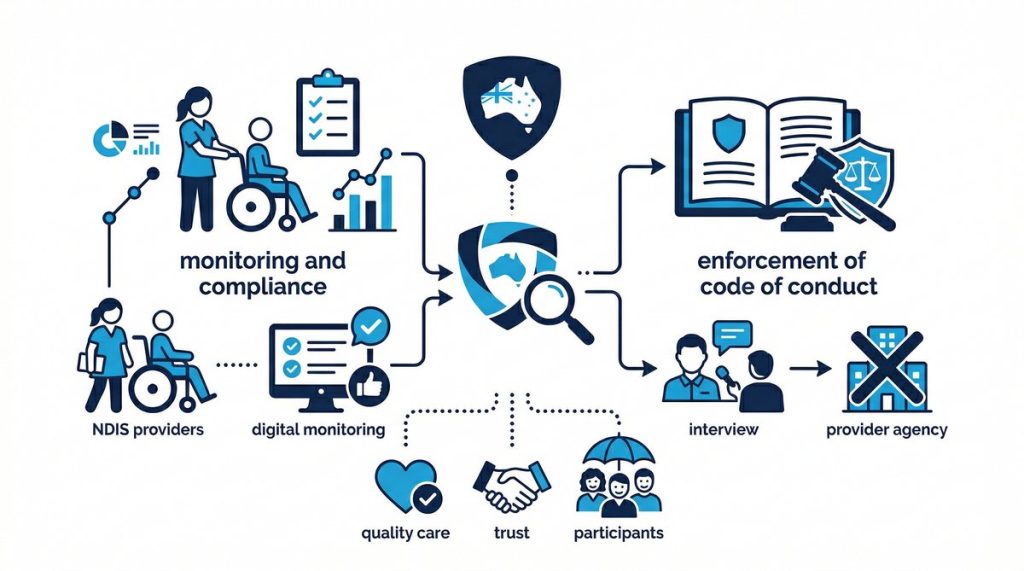
How the NDIS Commission Enforces the Code of Conduct
The NDIS Commission has significant legal powers to respond to Code of Conduct breaches. Understanding NDIS Commission code of conduct enforcement helps providers appreciate the real stakes of non-compliance — and the value of building a genuinely safe service culture.
The NDIS Code of Conduct is not a voluntary commitment. It is a legal obligation backed by a regulatory framework with teeth. Providers and workers who breach it face a graduated range of consequences — from education and compliance notices at the lower end, to banning orders, civil penalties, and criminal prosecution at the most serious end.
This deep dive explains the full NDIS Commission code of conduct enforcement spectrum, the investigation process, every available enforcement power, and the responsive regulation model that shapes how the Commission decides which action to take.
Understanding how enforcement works also helps providers build systems that prevent breaches. Reviewing the NDIS compliance checklist is a useful starting point for assessing your current exposure.
What Is the NDIS Commission’s Enforcement Role?
The NDIS Quality and Safeguards Commission is the national body responsible for regulating NDIS providers and workers. Its enforcement role is established under the NDIS (Provider Registration and Practice Standards) Rules and the broader NDIS Act. The Commission applies that role through a responsive regulation approach — matching enforcement intensity to the nature and severity of the non-compliance.
The Commission’s enforcement objectives are to:
- Protect participants from harm
- Deter providers and workers from non-compliant behaviour
- Maintain public confidence in the NDIS market
- Support providers who genuinely want to improve
- Hold those who repeatedly or wilfully breach the Code fully accountable
Enforcement is not purely punitive. The Commission uses education, guidance, and early intervention wherever these are likely to produce genuine behavioural change. However, when a provider or worker demonstrates wilful disregard for participant safety, the Commission does not hesitate to use its strongest powers.
The Enforcement Spectrum: From Education to Criminal Referral
NDIS Commission code of conduct enforcement operates across a spectrum. Each level represents an escalation in both the seriousness of the response and the consequences for the provider or worker.
Not all matters start at the bottom of the spectrum. The Commission assesses each case individually and may escalate immediately to a more serious response when the circumstances demand it. Serious incidents involving physical or sexual harm to a participant are likely to trigger the higher-tier responses from the outset.
The NDIS Commission’s published compliance and enforcement framework provides further detail on how these tiers operate in practice.
The Investigation Process
Before any enforcement action can be taken, the Commission conducts an investigation. Understanding this process helps providers and workers know what to expect if a complaint is lodged against them.
Complaint Receipt and Triage
When a complaint or concern is received, a case officer assesses its nature and severity. The officer determines whether the matter falls within the Commission’s jurisdiction and identifies the most appropriate initial response — early resolution, further enquiry, or formal investigation.
Formal Investigation
Where a formal investigation is opened, the Commission notifies the subject of the complaint. It may require the provider or worker to produce documents, attend interviews, or participate in an audit. The Commission has broad powers to compel cooperation under the NDIS Act.
Findings of Fact
The investigator gathers and assesses evidence from multiple sources: the complainant, the provider, workers, other participants, and documentary records. The Commission makes findings of fact — it determines what actually happened and whether it constitutes a Code breach.
Decision and Response
Based on the findings, the Commission decides on the appropriate enforcement response. The decision takes into account:
- Severity and impact of the breach
- Whether the breach was deliberate or negligent
- The provider’s or worker’s previous compliance history
- Whether the provider has taken remedial action
- The vulnerability of the participants involved
Providers facing investigation should review their incident management records and reportable incident documentation carefully, as these records often form part of the evidence the Commission examines.
NDIS Commission Enforcement Powers
The Commission has a broad and graduated set of NDIS Commission powers available to it. Each power is suited to a different type or severity of non-compliance.
Compliance Notices
Compliance notices are formal written directions requiring a provider or worker to take specific steps to remedy a breach. They are used when the Commission believes the subject can and will comply if directed. A compliance notice might require a provider to implement a new supervision procedure, complete staff training, or update their incident response processes.
Failure to comply with compliance notices is itself a breach of the NDIS Act. Persistent non-compliance escalates the enforcement response.
Infringement Notices
Infringement notices impose on-the-spot financial penalties for lower-level breaches. They function similarly to fines and allow the Commission to impose a consequence quickly without the time and cost of court proceedings. Providers can pay the penalty or elect to have the matter heard in court.
Enforceable Undertakings
An enforceable undertaking is a formal agreement between the Commission and a provider or worker. The subject commits to taking specific remedial actions within agreed timeframes. Undertakings are enforceable by court — if the subject breaches the undertaking, the Commission can seek court orders and penalties.
Undertakings are used when a provider demonstrates genuine willingness to address non-compliance. They are not a soft option — the Commission monitors compliance rigorously and will act if undertakings are not met.
Banning Orders
A banning order prevents an individual from providing specified NDIS supports, working with NDIS participants, or managing an NDIS provider. Banning orders are among the most serious enforcement powers the Commission holds. They are used when an individual poses an unacceptable risk to participants.
Banning orders issued
Duration: some are permanent
Register published online
Banning orders appear on the publicly searchable NDIS Commission register. Employers, participants, and members of the public can search the register to identify individuals who have been banned. The reputational consequence of a banning order is profound and long-lasting.
Registration Actions
The Commission can impose conditions on a provider’s registration, suspend registration, or cancel it entirely. Registration cancellation is the most severe action available against an organisation. A cancelled provider cannot legally deliver NDIS supports and may face prosecution if it continues to do so.
Registration actions have significant impacts on participants who rely on the provider’s services. The Commission considers this carefully and often requires providers to develop transition plans to minimise disruption when serious registration actions are taken.
Civil Penalties
Civil penalties are financial penalties imposed by a court following Commission-initiated legal proceedings. The NDIS Act specifies maximum penalty amounts for various breaches. Civil penalties are reserved for the most serious contraventions — particularly those involving harm to participants or deliberate, systemic non-compliance.
These civil penalties can be substantial. For registered providers, civil penalty amounts can reach tens of thousands of dollars per contravention. For individuals, the amounts are lower but still significant.
Criminal Referrals
When a breach also constitutes a criminal offence — such as assault, fraud, sexual abuse, or financial exploitation — the Commission refers the matter to police or the relevant prosecuting authority. The Commission coordinates with state and territory police, the Australian Federal Police, and other regulatory bodies as needed.
Criminal prosecution proceeds independently of the Commission’s civil enforcement action. A provider or worker may face both regulatory consequences from the Commission and criminal consequences in the courts.
Case Statistics
The NDIS Commission publishes annual data on its compliance and enforcement activities. These figures illustrate the real-world application of its enforcement powers and demonstrate that NDIS Commission code of conduct enforcement is active, not theoretical.
- Banning orders: Approximately 18 banning orders have been issued, covering a range of serious Code breaches including sexual misconduct, physical abuse, and financial exploitation of participants.
- Compliance notices: Hundreds of compliance notices are issued each year, making them the most commonly used enforcement tool.
- Enforceable undertakings: Numerous enforceable undertakings have been accepted from providers who have committed to remediation following investigation findings.
- Registration actions: The Commission has suspended and cancelled the registrations of providers found to pose unacceptable risks to participants.
- Criminal referrals: A number of matters have been referred to police, resulting in criminal investigations and, in some cases, prosecutions.
Key insight: The Commission’s enforcement data consistently shows that the most common triggers for serious enforcement action are sexual misconduct against participants and financial abuse. Both of these are addressed directly by obligations 7 and 4 of the Code.
The Responsive Regulation Model
The NDIS Commission’s approach to enforcement is based on responsive regulation — a model that tailors regulatory responses to the nature of the regulated entity’s behaviour. This model recognises that providers and workers breach the Code for different reasons, and that different reasons call for different responses.
The model distinguishes between:
- Willing compliers: Providers who want to comply but lack the knowledge, skills, or systems to do so. The Commission supports these providers through education, guidance, and targeted assistance.
- Reluctant compliers: Providers who comply only when required to. The Commission uses compliance notices, monitoring, and escalating consequences to drive behavioural change.
- Wilful non-compliers: Providers who knowingly or recklessly breach the Code. The Commission applies its most serious enforcement powers without hesitation.
This model means that the Commission’s first response to a complaint is not always the most punitive option available. Providers who respond constructively to Commission enquiries, demonstrate genuine remorse, and take prompt remedial action are treated differently from those who are defensive, obstructive, or repeat offenders.
However, the responsive regulation model does not reduce consequences for serious harms. When participants are injured, abused, or exploited, the Commission acts at the serious end of the spectrum regardless of the provider’s subsequent attitude.
People Also Ask
How does the NDIS Commission decide between enforcement options?
The Commission considers the severity of the breach, the impact on participants, the provider’s compliance history, and whether the provider has taken remedial action. Its responsive regulation model guides this assessment, but participant safety always takes priority.
Can a banning order be appealed?
Yes. A person subject to a banning order can apply to the Administrative Appeals Tribunal (AAT) for a review of the decision. The Commission’s original decision remains in effect during the review unless the AAT orders otherwise.
Are civil penalties covered by professional indemnity insurance?
Generally, civil penalties are not covered by insurance because they are imposed as a consequence of intentional or reckless conduct. Providers should not assume that insurance will shield them from financial consequences of Code breaches.
Does the NDIS Commission publish a list of sanctioned providers?
Yes. The NDIS Commission maintains a public register that includes information on banning orders and significant registration actions. Participants, employers, and the public can search this register to identify individuals and organisations that have been sanctioned.
Can enforcement action affect a worker’s NDIS Worker Screening clearance?
Yes. Adverse findings from a Code of Conduct investigation can be taken into account in worker screening decisions. A banning order will ordinarily also result in the worker’s screening clearance being revoked or not renewed.
What should a provider do if it receives a compliance notice?
Take it seriously. Review the notice carefully, seek legal advice if needed, and respond within the required timeframe. Document all steps taken to comply. Failing to comply with compliance notices escalates the enforcement response significantly.
How Inficurex Helps Providers Stay Ahead of Enforcement
The best defence against NDIS Commission code of conduct enforcement is a robust compliance program that identifies and addresses risks before they become complaints. Inficurex provides the tools and frameworks to make this achievable.
With Inficurex, providers can:
- Use the NDIS compliance checklist to assess their current compliance position across all Code obligations
- Build a complete understanding of their obligations using the Code of Conduct provider guide
- Maintain compliant incident management systems using the incident management framework
- Stay aligned with NDIS Practice Standards across their full service portfolio
- Manage worker screening status and compliance records using the worker screening guide
- Streamline documentation and audit readiness using NDIS provider software
Understanding enforcement is important. Avoiding the need for enforcement is better. Providers who prioritise genuine compliance — not just documentation — consistently demonstrate stronger audit outcomes and build lasting trust with participants and families.
Review the NDIS provider registration checklist for 2025 to ensure your organisation’s compliance posture meets current Commission expectations.