
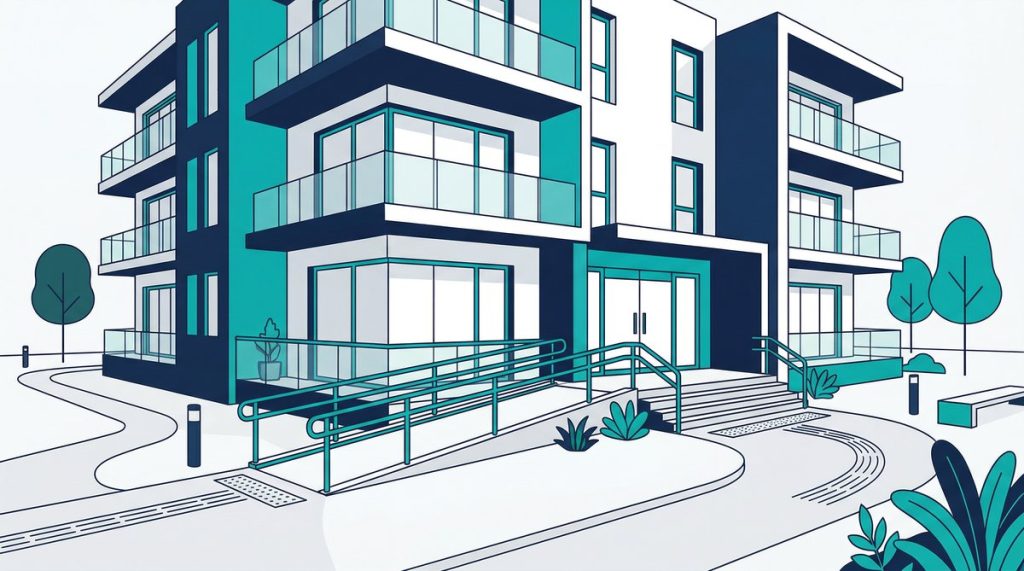
NDIS Specialist Disability Accommodation (SDA): A Provider’s Guide to Registration, Design Categories, and Funding
NDIS SDA represents one of the most specialised — and potentially lucrative — segments of the National Disability Insurance Scheme. As of September 2025, 25,274 participants carry SDA funding in their plans, with nearly 9,756 still actively seeking suitable dwellings. For providers and investors willing to navigate the complexity, returns of 8–12% per annum are achievable. However, the compliance burden is significant, and the consequences of getting it wrong are severe.
This NDIS SDA provider guide walks you through everything you need to know — from the four design categories and 2025-26 pricing rates to the step-by-step registration process, dwelling enrolment, and ongoing compliance obligations. Whether you are a property developer exploring the SDA market or an existing disability provider expanding your services, this guide covers the essentials.
What Is Specialist Disability Accommodation (SDA)?
Specialist Disability Accommodation (SDA) is purpose-built or modified housing for NDIS participants with extreme functional impairments or very high support needs. SDA funding covers the physical housing structure — the “bricks and mortar” — not personal support services, which are funded separately through SIL rostering and other core supports.
Understanding this distinction is fundamental to every aspect of this NDIS SDA provider guide. As an SDA provider, you are essentially a specialised landlord. Your role is to own or manage properties that meet strict design standards, maintain compliance, handle tenancy relationships, and receive payments directly from the NDIA once an eligible participant occupies your enrolled dwelling.
SDA vs Other NDIS Accommodation Supports
SDA sits within the Capital Support budget of a participant’s NDIS plan. This makes it distinct from Supported Independent Living (SIL), which funds support workers and falls under Core Supports. It also differs from Individualised Living Options (ILO) and Medium Term Accommodation (MTA), which serve different purposes. Only participants assessed as having extreme functional impairment or very high support needs qualify for SDA — making it a highly targeted allocation representing just 0.93% of all annualised NDIS supports.
SDA Market Size
The SDA market has grown rapidly. Total SDA payments reached $481 million by September 2025, nearly doubling from $242 million just two years earlier. With 25,274 funded participants and approximately 11,360–12,396 enrolled dwellings across Australia, the market continues to expand — although supply dynamics vary significantly by state and design category.
NDIS SDA Design Categories Explained
The NDIS SDA Design Standard defines four design categories, each addressing a different level and type of functional impairment. Choosing the right category is one of the most consequential decisions for any SDA provider or investor, as it directly determines construction requirements, target participants, and funding levels. This section of our NDIS SDA provider guide breaks down each category in detail.
Improved Liveability
Improved Liveability targets participants with sensory, intellectual, or cognitive impairments — including autism spectrum disorder, intellectual disability, acquired brain injury, and cognitive processing difficulties. The design focus centres on reducing sensory overload and supporting daily routines through thoughtful design choices.
Key features of Improved Liveability dwellings include enhanced lighting and luminance contrasts, improved acoustic performance for noise reduction, clear wayfinding and visual cues throughout the home, level entry, and wider doorways meeting Liveable Housing Australia Silver Level standards. Importantly, this category does not include specialised features for significant physical disabilities — its focus remains on sensory and cognitive accessibility.
For providers, Improved Liveability represents the lowest funding tier among SDA design categories NDIS recognises, with metro new-build apartment rates starting at approximately $42,847 per year. However, lower construction costs can make it an attractive entry point.
Fully Accessible
Fully Accessible dwellings are designed for participants with significant physical impairment, particularly wheelchair users who require frequent physical assistance. The design philosophy removes physical barriers to allow full mobility throughout every area of the home.
These properties feature zero-step entry, wide doorways meeting wheelchair-accessible specifications, accessible bathrooms with roll-in showers, accessible kitchen design, open floor plans accommodating powered or manual wheelchairs, and accessible outdoor areas. Every space in the dwelling must be usable by someone in a wheelchair without assistance for navigation.
Fully Accessible dwellings command higher SDA funding than Improved Liveability, with metro new-build apartment rates reaching approximately $56,940 per year for a one-bedroom configuration.
Robust
Robust housing serves participants with psychosocial disability, complex behavioural support needs, or high-intensity behaviours that may result in property damage. The design challenge is significant: creating durable, secure housing that maintains safety while avoiding an institutional feel.
Robust dwellings incorporate all Fully Accessible features plus reinforced walls, impact-resistant materials, secure fittings and fixtures resistant to damage, and acoustic isolation to reduce sensory triggers. The construction must be exceptionally resilient to reduce reactive maintenance demands.
This category is one of the fastest-growing SDA design categories NDIS providers should monitor. According to SDA Australia Group’s quarterly report, Robust enrolled dwellings grew by 63% as of Q1 2025, reflecting strong demand. Metro new-build apartment rates reach approximately $62,050 per year.
High Physical Support
High Physical Support (HPS) is the highest-funded SDA category, designed for participants with very high physical support needs, complex medical requirements, or progressive neurological conditions such as Motor Neurone Disease or advanced Multiple Sclerosis. These participants require specialised equipment and typically need 24/7 care access.
HPS dwellings include all Fully Accessible features plus reinforced ceiling structures for tracking hoists through bedrooms, bathrooms, and living areas. Emergency backup power (minimum two hours) is mandatory for life-sustaining equipment. Extra-wide doorways with at least 95cm clear openings, wider ceiling heights for specialised equipment, advanced home automation, health monitoring technology, and medical equipment power supplies with surge protection are all required.
Additionally, HPS properties must include dedicated on-site overnight assistance (OOA) accommodation with a separate entry for support workers. This category has seen 49% growth in enrolled dwellings as of Q1 2025, and metro new-build apartment rates reach approximately $94,170 per year — making it the most lucrative option for providers who can meet the stringent requirements.
Design Category Comparison Table
| Feature | Improved Liveability | Fully Accessible | Robust | High Physical Support |
|---|---|---|---|---|
| Primary need addressed | Sensory / cognitive | Physical mobility | Complex behaviour | High physical + medical |
| Wheelchair access | Partial | Full | Full | Full (enhanced) |
| Durable construction | No | No | Yes | Yes |
| Ceiling hoist provision | No | No | No | Yes (mandatory) |
| Emergency backup power | No | No | No | Yes (min. 2 hours) |
| Home automation | No | No | No | Yes |
| Annual funding (metro new-build 1-bed apartment) | ~$42,847 | ~$56,940 | ~$62,050 | ~$94,170 |
| Demand growth (2024-25) | Moderate | Moderate | 63% | 49% |
SDA Building Types and Dwelling Classifications
Beyond design categories, NDIS SDA Pricing Arrangements recognise four building types, each carrying different price limits. Understanding these classifications is essential for any provider working through this NDIS SDA provider guide, as building type directly affects your revenue potential.
The Four Building Types
Apartments are multi-unit residential buildings and typically the most cost-effective option for urban locations. Villas, duplexes, and townhouses are semi-detached or attached dwellings that offer a middle ground between density and independence. Houses are standalone dwellings with no shared walls, driveways, or communal areas with ancillary dwellings. Group homes provide shared accommodation for multiple SDA participants and generally attract lower per-bed funding.
New Build vs Existing vs Legacy Stock
The age and classification of an SDA dwelling significantly affects its funding level. New Build dwellings — those with a certificate of occupancy dated on or after 1 April 2016 — attract the highest payment rates and must meet the full SDA Design Standard with certification by an accredited SDA assessor. They accommodate up to five residents or a participant with their immediate family.
Existing Stock refers to properties used for disability accommodation between 1 July 2013 and 1 December 2016 that are not classified as New Build. These attract moderate payment rates and must have been used for disability accommodation previously.
Legacy Stock includes existing properties housing more than five residents. These attract the lowest payment rates, and the NDIA plans to phase out Legacy Stock payments over time. Providers holding Legacy Stock should plan for this transition.
How Building Type Affects Pricing
The funding hierarchy flows clearly: New Build properties receive the highest rates, followed by Existing Stock, and then Legacy Stock. Within New Build properties, houses and villas generally attract higher rates than apartments, while group homes attract lower per-bed rates. For example, a High Physical Support new-build villa commands approximately $97,455 per year compared to $94,170 for an equivalent apartment. Providers must model these differences carefully when evaluating SDA funding viability for a project.
NDIS SDA Pricing and Payments 2025-26
Understanding the pricing framework is critical for any provider entering the SDA market. This section of our NDIS SDA provider guide covers the full pricing structure, payment mechanics, and participant contribution model effective from 1 July 2025.
2025-26 Annual Maximum Price Limits (Metro New Build)
| Design Category | 1-Bed Apartment | 2-Bed Apartment | 1-Bed Villa/Duplex | 2-Bed Villa/Duplex | Group Home (per bed) |
|---|---|---|---|---|---|
| Improved Liveability | $42,847 | $49,275 | $46,355 | $52,560 | $35,040 |
| Fully Accessible | $56,940 | $63,510 | $60,225 | $66,430 | $43,800 |
| Robust | $62,050 | $68,620 | $65,700 | $71,905 | $47,450 |
| High Physical Support | $94,170 | $104,025 | $97,455 | $107,675 | $69,350 |
Source: NDIS SDA Pricing Arrangements and Price Limits 2025-26. Rates shown are metro new-build maximum annual amounts per participant.
Location Loading
Providers operating outside metropolitan areas benefit from location-based price loading. Regional locations attract approximately 8% additional funding, remote areas approximately 20%, and very remote locations up to 25% above metro rates. If your dwelling includes an on-site overnight assistance (OOA) room for a support worker, additional price loading applies on top of these base rates.
Maximum Reasonable Rent Contribution (MRRC)
Participants are not fully subsidised. Each SDA resident contributes a capped rent amount known as the Maximum Reasonable Rent Contribution (MRRC). This comprises up to 25% of the base Disability Support Pension (DSP) rate — approximately $247 per week or $12,856 per year in 2025 — plus up to 25% of any Pension Supplement and up to 100% of any Commonwealth Rent Assistance they receive. The MRRC increased in March 2025 in line with DSP indexation adjustments.
Provider Payment Formula
The payment formula for SDA providers is straightforward:
Provider Annual Income = SDA Price Limit − Participant MRRC
For a High Physical Support one-bedroom apartment in a metro area, this works out to approximately $94,170 minus $12,856, yielding around $81,314 per year from the NDIA plus $12,856 from the participant. SDA prices are indexed annually on 1 July, and payments are collected automatically through the NDIS Participant Portal — providers do not need to invoice per service. This predictable income stream is one of the key attractions of the SDA model for providers navigating this NDIS SDA provider guide.
How to Become a Registered NDIS SDA Provider
Becoming an SDA provider requires formal NDIS registration through the NDIS Quality and Safeguards Commission. Unlike some other NDIS support categories, SDA registration has always been mandatory — there is no option to operate as an unregistered SDA provider. The following five steps outline the complete pathway, forming the core of the SDA registration requirements providers must meet.
Step 1: Market Research and Due Diligence
Before committing capital, conduct thorough market research using the NDIA’s SDA Demand Data tool to assess demand by location and design category. With national utilisation rates at just 42%, location selection is paramount. Properties beyond 15–35 km from CBDs are increasingly classified as high-risk by lenders, and some postcodes have been blacklisted for SDA financing altogether.
Identify which design category aligns with local demand. Robust and High Physical Support categories show the strongest growth, while some metro areas are experiencing oversupply in other categories. Engage financial advisors experienced in SDA investment, and consult with accredited SDA assessors early to validate your property concept against the Design Standard.
Step 2: NDIS Provider Registration
The registration process begins with creating a myID account and establishing RAM (Relationship Authorisation Manager) access — the PRODA system is being phased out and new providers cannot create PRODA accounts. Applications must be submitted within 60 days of starting or they are automatically deleted.
Your online application must include organisation contact details and ABN, business structure details, key personnel information with suitability declarations, the Specialist Disability Accommodation registration group selection, self-assessment responses demonstrating understanding of NDIS Practice Standards, aligned policies and procedures, financial viability evidence, public liability insurance, and NDIS Worker Screening Clearances for all key personnel.
Key personnel must declare they have not been convicted of an indictable offence, been insolvent or under administration, been subject to adverse findings by regulatory bodies including WorkSafe, ASIC, ACCC, or AUSTRAC, or been disqualified from managing corporations. All must maintain 100 points of ID.
Step 3: Property Development or Acquisition
Once you understand the SDA registration requirements, engage an accredited SDA assessor at the design stage — before construction begins. Early engagement is strongly recommended to address design standard compliance issues before they become costly construction problems. Your property must meet the full SDA Design Standard for your nominated category, including all structural, accessibility, and specialist requirements.
Simultaneously, prepare for the certification audit required for registration. Develop comprehensive policies and procedures, ensure all worker screening clearances are valid, and run internal mock audits to identify gaps. SDA registration requires a Certification Audit — more comprehensive than the Verification audit used for some other NDIS registration groups.
Step 4: Dwelling Enrolment
After receiving registration approval and completing your property, each individual SDA dwelling must be enrolled separately with the NDIA. This involves obtaining an as-built certification from your SDA assessor confirming the completed dwelling meets the Design Standard, then submitting the enrolment application with all required documentation via the my NDIS Provider Portal. We cover this process in detail in the next section.
Step 5: Tenant Matching and Onboarding
With your dwelling enrolled, you can begin matching participants. Notify the NDIA of vacancies through their online systems — this is a mandatory obligation, not optional. Work with support coordinators and Local Area Coordinators to connect with participants who have SDA in their plans and whose needs match your dwelling’s design category. Consider engaging specialist SDA vacancy listing services to improve your matchmaking outcomes. Vacancy is the primary financial risk for SDA providers, so proactive tenant acquisition is essential.
SDA Dwelling Enrolment Process
The dwelling enrolment process is a critical milestone that sits between NDIS registration and receiving your first SDA funding payment. Every individual property must be enrolled, and the process involves multiple verification stages.
Two-Stage Assessor Certification
An accredited SDA assessor must certify your dwelling at two separate stages. At the design stage, the assessor reviews your architectural plans to confirm compliance with the SDA Design Standard for your nominated category. At the as-built stage, the assessor physically inspects the completed dwelling and issues a formal compliance certificate. A critical rule applies: assessors cannot certify properties they designed, constructed, or managed — ensuring independence in the certification process.
Required Documentation
Your enrolment submission must include proof of ownership or legal authority (such as a title or lease agreement), a Certificate of Occupancy, the SDA assessor certification confirming compliance with the relevant design standard, and a detailed property description covering design category, building type, number of residents, and OOA provisions. This documentation package is submitted through the my NDIS Provider Portal, which now requires myID and RAM credentials.
Post-Enrolment Obligations
Once enrolled, providers must maintain the property consistent with its enrolled design category, building type, occupancy number, and OOA provisions. Any changes must be reported to the NDIA promptly. Failure to maintain these conditions can result in loss of enrolment and withdrawal of SDA funding — an outcome that would immediately halt your income stream. For more on maintaining compliance records, see our NDIS compliance checklist.
SDA vs SIL: Key Differences for Providers
The distinction between SDA and SIL is one of the most common sources of confusion in the NDIS housing sector. Both frequently apply to the same participant, but they fund entirely different things and carry different provider obligations. Understanding this distinction is central to any comprehensive NDIS SDA provider guide.
| Dimension | SDA (Specialist Disability Accommodation) | SIL (Supported Independent Living) |
|---|---|---|
| What it funds | The building / housing infrastructure | Support workers and daily living assistance |
| Provider analogy | Specialised landlord | Staffing agency / rostering service |
| NDIS plan budget | Capital Support budget (restricted) | Core Support budget (“Assistance with Daily Life”) |
| Provider role | Own/manage property; ensure design standard compliance; manage tenancy | Recruit, train, roster support workers; deliver daily assistance |
| Can they be combined? | Yes — many participants receive both SDA and SIL | Yes — SDA + SIL is the most common arrangement |
| Must be same provider? | No — participant chooses independently | No — separation is often recommended |
| Eligibility basis | Extreme functional impairment / very high support needs requiring specialised housing | Significant ongoing need for daily support (usually 8+ hours/day) |
| Compliance burden | Higher — design standards, building certification, enrolment, property maintenance | Lower, but increasing with mandatory registration from 2025-26 |
Here is a practical example: a participant lives in a High Physical Support SDA house, funded by their Capital budget and paid to the SDA provider. Separately, a SIL provider sends support workers to help with personal care, cooking, and medication management, funded from the Core Support budget. The participant chooses each provider independently, and NDIS policy is built on this separation to maximise choice and control.
Providers who offer both SDA and SIL services must implement robust conflict of interest processes to ensure participant rights are protected.
Ongoing SDA Compliance Obligations
Registration and enrolment are only the beginning. SDA providers carry extensive ongoing obligations that require consistent attention and robust systems. Failing to meet these obligations can result in enforcement action, funding withdrawal, or worse. The following eight categories outline the full scope of compliance duties covered in this NDIS SDA provider guide.
1. Property Maintenance
Keep all SDA properties in a good state of repair at all times. Every accessibility feature must remain fully functional — not merely addressed when broken. The dwelling must continuously meet its assigned SDA design categories NDIS standard, with no degradation over time.
2. Tenancy Management
Uphold residents’ rights and their choice of supports. Manage tenancy agreements with clear, accessible communications, and ensure participants are involved in decisions about their accommodation. Robust conflict of interest processes must be in place, particularly if you also deliver SIL or other supports.
3. Incident and Complaints Management
Respond swiftly to incidents and complaints, maintain robust reporting systems, and document all complaints and resolutions. The NDIS Quality and Safeguards Commission expects evidence of systematic incident management — not ad hoc responses. For guidance on establishing these systems, see our NDIS incident management guide.
4. Collaboration with Other Providers
Proactively collaborate with SIL providers and other providers operating within the dwelling. Coordinate with healthcare professionals and support coordinators to ensure participant wellbeing across all service touchpoints.
5. NDIA Reporting
Notify the NDIA of any vacancies via their online systems — this is mandatory, not optional. Report changes to design category, building type, occupancy, or any modifications affecting compliance. Failure to notify can result in loss of enrolment and withdrawal of SDA funding.
6. Regulatory Compliance
SDA providers are subject to regular re-registration audits by NDIS-approved auditors. You must maintain compliance with NDIS Practice Standards (SDA module) and keep valid NDIS Worker Screening Checks for all risk-assessed roles. Updated practice standards are currently in development following 2024 consultations.
7. Financial Record-Keeping
Maintain meticulous records of all transactions, tenancy agreements, maintenance records, and incidents. Ensure SDA pricing remains within NDIS price limits, and confirm that participant rent contributions do not exceed the Maximum Reasonable Rent Contribution (MRRC) caps.
8. Enforcement Consequences
The consequences of non-compliance are escalating across the sector. The NDIA can withdraw SDA funding for enrolled dwellings, and the NDIS Commission can pursue enforcement action including registration cancellation. In a landmark case in January 2025, the Federal Court imposed a $1.9 million penalty on Valmar Support Services Limited for failures that contributed to a participant’s death — sending a clear signal of intensified enforcement across the sector.
How Inficurex Helps SDA Providers
Managing SDA operations alongside SIL delivery creates operational complexity that manual processes cannot sustain. Inficurex is purpose-built NDIS software that helps SDA and SIL providers manage multi-participant rostering, automated billing, and compliance obligations from a single platform.
For SDA providers, Inficurex streamlines SDA and SIL billing with automated claim generation aligned to current NDIS price limits. The platform’s rostering module handles complex shared-living arrangements where multiple participants in a single dwelling receive different support schedules. Built-in compliance tracking helps you maintain audit-ready records for incident management, worker screening, and tenancy documentation — reducing the administrative burden that comes with ongoing SDA registration requirements and keeping your operations aligned with NDIS Practice Standards.
Frequently Asked Questions
Do I need to register to provide SDA housing?
Yes. SDA is strictly regulated and requires formal NDIS registration through the NDIS Quality and Safeguards Commission. Only registered SDA providers can receive SDA payments from the NDIA. There is no unregistered pathway for SDA, unlike some other NDIS support categories.
Can a new business or sole trader become an SDA provider?
Yes. Sole traders, new businesses, property developers, community housing organisations, and companies with a valid ABN can all apply. No minimum years of operation are required, although you must pass a certification audit and demonstrate suitability of all key personnel.
What is the typical return on investment for SDA properties?
Well-selected and managed SDA properties typically yield 8–12% per annum. High Physical Support new-build properties have the highest potential returns, with annual rates of up to $117,520 per participant before MRRC deduction. However, vacancy is the primary financial risk — national utilisation sits at only 42%.
What happens if my SDA property is vacant?
The NDIA does not pay SDA rates when a property is unoccupied. Some limited vacancy provisions apply under the SDA Rules, but extended vacancies represent a significant financial risk. Providers must notify the NDIA of vacancies and should actively work with support coordinators and vacancy listing services to match tenants.
Can my SDA provider also be my SIL provider?
Yes, but it is not required. Participants have the right to choose each provider separately, and keeping SDA and SIL providers separate is often recommended to maximise participant choice and avoid conflicts of interest. Providers offering both must implement robust conflict of interest management processes.
What is the Maximum Reasonable Rent Contribution (MRRC)?
The MRRC is the capped amount a participant pays toward rent in their SDA property — approximately 25% of the base Disability Support Pension (~$247/week in 2025), plus portions of Pension Supplement and Commonwealth Rent Assistance. The NDIA pays the remainder of the SDA price limit directly to the provider.
How long does the SDA provider registration process take?
Timelines vary, but providers should allow three to six months from application to approval, depending on the completeness of documentation and audit scheduling. Applications must be submitted within 60 days of starting, or they are automatically deleted. Engaging an NDIS-approved auditor early can help avoid delays. Review the full NDIS provider registration checklist to prepare efficiently.
Does SDA cover the cost of support workers?
No. SDA funds only the housing infrastructure — the building, maintenance, and compliance with design standards. Support workers are funded separately under SIL or other NDIS core supports within the participant’s plan. This separation is fundamental to the NDIS model and ensures participants can choose their SDA and SIL providers independently.