
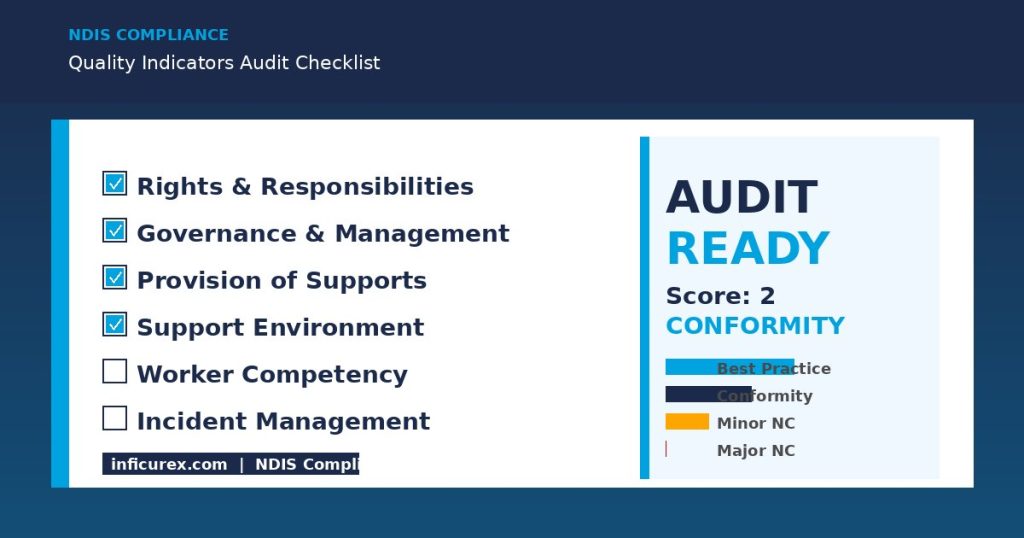
NDIS Quality Indicators: A Practical Compliance Checklist

NDIS quality indicators are the specific criteria auditors use to assess whether a registered provider has achieved each quality outcome under the NDIS Practice Standards. Yet despite their central role in registration and audit, few practical compliance checklists exist that break down exactly what evidence you need for each indicator. This guide fills that gap. Whether you are preparing for your first certification audit, working through a recertification cycle, or conducting an internal readiness review, this checklist-based resource gives you a clear, actionable framework for demonstrating NDIS compliance evidence across every practice standard area — from rights and responsibilities through to the specialist support environment. Understanding these NDIS quality indicators before an auditor arrives is the most effective audit preparation investment a provider can make.
What Are NDIS Quality Indicators?
NDIS quality indicators are the measurable criteria within each NDIS Practice Standard that describe the systems, processes, structures, skills, and behaviours required to achieve each quality outcome. Auditors use them to assess whether a provider’s operations conform to the expected standard.
Each Practice Standard contains a set of quality outcomes — high-level, participant-focused statements about the result a provider should be achieving. Within each outcome, quality indicators specify the operational detail auditors look for. The NDIS Quality Indicator Guidelines, published by the NDIS Commission, describe exactly what each indicator means and the types of evidence that demonstrate conformity.
Providers do not prescribe how they meet each indicator — the specific systems and processes used can vary based on organisational size, scale, and the complexity of supports delivered. This proportional approach means a sole trader delivering lower-complexity supports will not need the same depth of documentation as a large organisation delivering high intensity daily activities. For a comprehensive overview of the standards framework, see our NDIS Practice Standards guide.
How NDIS Quality Indicators Audits Work
The Two Audit Pathways
NDIS providers access two audit pathways depending on the supports they deliver:
- Verification Audit: For lower-risk, lower-complexity providers. This is a desktop audit assessing four quality indicators: Human Resource Management, Incident Management, Complaints Management, and Risk Management. Evidence is submitted electronically to an approved quality auditor.
- Certification Audit: For providers of more complex or higher-risk supports. This involves a full assessment against all applicable Core Module standards and any relevant supplementary modules. Certification audits include document review, staff interviews, participant interviews, and may include site visits.
If you are uncertain which pathway applies to your organisation, review the NDIS Commission’s registration group guidance or consult our NDIS provider registration checklist.
How Auditors Score Compliance
Auditors evaluate evidence against a four-point conformity scale. Understanding this scale helps you gauge the quality of evidence you need to prepare:
| Score | Rating | What It Means |
|---|---|---|
| 3 | Best Practice Conformity | Innovative, responsive service delivery with clear evidence of continuous improvement |
| 2 | Conformity | Clear demonstration that outcomes and indicators are met, proportionate to provider size and scale; negligible risk |
| 1 | Minor Non-Conformity | Process is evident but supporting documentation is missing or review has not been demonstrated; corrective action plan required |
| 0 | Major Non-Conformity | Appropriate processes or structures cannot be demonstrated; registration is precluded until resolved |
To achieve registration, all applicable quality indicators must be rated at conformity (score 2) or higher. Three minor non-conformities within the same module may be elevated to a major non-conformity. A major non-conformity on any indicator prevents certification until resolved through a corrective action plan and follow-up review.
NDIS Quality Indicators Checklist: Core Module
The Core Module applies to all registered providers delivering higher-risk supports. It comprises four Practice Standard areas, each containing specific quality indicators. Use the checklists below to assess your readiness across each area.
Standard 1: Rights and Responsibilities
This standard covers five indicators. The practice standards checklist items for this area are:
- Person-Centred Supports: Evidence that supports reflect individual participant goals, preferences, and decision-making. Required evidence: support plans referencing participant goals, notes documenting how participant preferences shaped support delivery, and service agreement content confirming participant choice.
- Individual Values and Beliefs: Evidence that cultural, spiritual, and personal values are respected. Required evidence: staff training records on cultural competency, individual support plans noting cultural or personal preferences, and policies covering cultural safety.
- Privacy and Dignity: Documented privacy procedures and evidence they are implemented. Required evidence: privacy policy reviewed within the past 12 months, signed participant consent forms, staff training records on privacy obligations, and information management procedures.
- Independence and Informed Choice: Evidence that participants make informed decisions and are supported to maximise independence. Required evidence: service agreements with plain-English explanations of services, documentation of choices made by participants, and records of information provided to participants about alternatives.
- Violence, Abuse, Neglect, Exploitation and Discrimination (VANED): Evidence that supports are free from VANED and that the organisation has systems to prevent and respond to it. Required evidence: VANED policy, staff training records, incident registers with VANED categorisation, and records of VANED-related reportable incidents.
Standard 2: Provider Governance and Operational Management
This standard contains nine indicators and represents the broadest evidence requirements in the Core Module. Key checklist items include:
- Governance and Operational Management: Robust governance systems proportionate to organisational size and complexity. Evidence: organisational structure chart, board or management governance documents, and documented operational procedures.
- Risk Management: Documented risk identification and management processes. Evidence: current risk register, risk management policy, records showing risks have been reviewed and acted upon, and participant-specific risk assessments where relevant.
- Quality Management: A quality management system promoting continuous improvement. Evidence: quality management policy, records of quality improvement activities (e.g., audits, reviews, improvement projects), and participant feedback used to drive change.
- Information Management: Accurate, current, confidential information management systems accessible to participants. Evidence: information management policy, data security procedures, records showing participant information is reviewed and updated, and evidence of participant access to their own records.
- Feedback and Complaints Management: Accessible complaints management system with respectful, timely resolution. Evidence: complaints policy, complaints register for the past 12 months, records of complaint investigations and outcomes, and evidence that feedback has informed improvements. See also our NDIS compliance checklist.
- Incident Management: Effective incident management system that safeguards participants and meets NDIS Commission reporting requirements. Evidence: incident management policy, incident register, records of investigations and root cause analysis, and evidence of NDIS Commission notifications for reportable incidents. Our NDIS incident management guide covers this requirement in detail.
- Human Resource Management: Competent workers with relevant qualifications, expertise, and experience. Evidence: position descriptions, recruitment records, qualification verification records, NDIS worker screening clearances for risk-assessed roles, induction records, and ongoing professional development logs.
- Continuity of Supports: Timely, appropriate support without interruption. Evidence: business continuity plan, records showing how participant supports were maintained during worker absences, and transition procedures.
- Emergency and Disaster Management: Documented emergency and disaster management procedures. Evidence: emergency management plan reviewed within the past 12 months, staff training records, and evidence of plan testing or review.
Standard 3: Provision of Supports
This standard covers five indicators relating to how supports are actually delivered to participants:
- Access to Supports: Supports that meet participant needs, goals, and preferences. Evidence: access and intake procedures, records showing how participant support needs were assessed at intake, and evidence that supports were matched to identified needs.
- Support Planning: Active participant involvement in developing and reviewing support plans. Evidence: support plans signed by participants, records of plan reviews involving the participant, and evidence of participant goal-setting processes.
- Service Agreements with Participants: Clear written agreements covering all aspects of the service relationship. Evidence: current service agreements for all active participants, version-controlled agreement templates, and records of how agreements have been explained to participants. For template guidance, see our NDIS service agreement template.
- Responsive Support Provision: Timely, competent, and appropriate supports meeting participant needs. Evidence: rostering and scheduling records showing supports were delivered as planned, records of how unmet support needs were escalated, and participant feedback on support responsiveness.
- Transitions to or From a Provider: Planned and coordinated transitions that minimise disruption to participants. Evidence: transition planning documentation, records of communication with receiving providers, and participant consent records for information sharing during transitions.
Standard 4: Provision of Supports Environment
This standard covers five indicators regarding the physical and operational environment in which supports are provided:
- Safe Environment: Safe, appropriate environments for support delivery. Evidence: workplace health and safety procedures, hazard identification records, equipment maintenance logs, and records of environmental risk assessments for participant settings.
- Participant Money and Property: Secure management of participant money and property. Evidence: documented procedures for managing participant money, receipts and transaction records, and records of participant consent for any financial management activities.
- Management of Medication: Safe administration, storage, and monitoring of participant medication. Evidence: medication management policy, medication administration records (MARs), records of medication-related incidents, and training records for workers involved in medication management.
- Mealtime Management: Nutritious, appropriately prepared meals tailored to individual needs. Evidence: mealtime management plans for participants with specific dietary requirements, staff training records on mealtime support, and evidence of dietitian or speech pathologist involvement for participants with complex needs.
- Management of Waste: Protection from harm due to exposure to waste or hazardous substances. Evidence: waste management procedures, personal protective equipment (PPE) policies, staff training records on waste management, and records of any waste-related incidents.
Verification Module Quality Indicators Checklist
Providers on the verification pathway must meet four quality indicators. The evidence requirements are less extensive than certification but still require demonstrable systems rather than policies alone.
- Human Resource Management: Evidence that workers are suitable and have appropriate qualifications. Required: NDIS worker screening clearances, qualification verification records, reference check records, and induction completion records.
- Incident Management: Evidence of a system for identifying, recording, and managing incidents. Required: incident management procedure, incident register, and records showing incidents were investigated and actioned appropriately.
- Complaints Management: Evidence of an accessible and effective complaints system. Required: complaints procedure, complaints register, and evidence complaints were investigated and resolved in a timely manner.
- Risk Management: Evidence of a system for identifying and managing risks. Required: risk management procedure and evidence that risks relevant to your supports have been identified and have mitigation actions in place.
Common Gaps in NDIS Compliance Evidence
Providers who struggle in audits typically fail not because they lack systems, but because they cannot demonstrate that systems are implemented and maintained. The following gaps appear most frequently across quality indicators audits:
Documentation Is Present But Not Current
Policies and procedures exist but have not been reviewed within the required timeframe. Auditors look for evidence that documents are reviewed and updated regularly. Every policy should carry a review date, and your quality management system should include a scheduled review cycle. Auditors will note documents that are clearly outdated relative to regulatory changes.
Processes Exist but Implementation Cannot Be Demonstrated
This is the most common cause of minor non-conformity findings. A policy states that participant feedback will be reviewed quarterly, but no records of those reviews exist. Ensure that every process in your documentation has corresponding records showing it has been implemented. Think of your policies as promises — your records prove you kept them.
Worker Training Is Incomplete or Not Recorded
Human resource management quality indicators require evidence of appropriate training across a broad range of areas. Gaps in training records — particularly for the NDIS mandatory worker orientation module, Code of Conduct training, and role-specific competencies — frequently generate non-conformity findings. Maintain comprehensive training logs and ensure records are updated in real time, not reconstructed before audits.
Incident Registers Are Incomplete
Incident registers with missing fields, unanswered incidents, or no evidence of root cause analysis are a recurring audit issue. Every incident should be fully documented, investigated proportionate to severity, and closed with an outcome and any improvement actions recorded. For detailed guidance, refer to our NDIS reportable incidents guide.
Service Agreements Are Generic or Outdated
Service agreements must reflect the participant’s actual current supports. Generic agreements that do not describe the specific supports being provided, or agreements that have not been updated after plan reviews, fail the service agreement quality indicator. Review service agreements at every NDIS plan review and whenever supports change materially.
Building an Audit-Ready Evidence System
Passing an NDIS quality indicators audit with confidence requires systematic evidence management rather than last-minute document gathering. The following framework helps providers maintain continuous audit readiness.
Map Every Quality Indicator to an Evidence Owner
For each applicable quality indicator, identify who in your organisation owns that evidence — who creates it, maintains it, and ensures it is current. Without clear ownership, evidence gaps emerge gradually until they become significant non-conformities. This ownership mapping is the foundation of your compliance management system.
Schedule Regular Evidence Reviews
Build a 12-month compliance calendar that schedules evidence reviews for each quality indicator area. High-risk indicators — incident management, worker screening, medication management — should be reviewed more frequently (monthly or quarterly). Lower-risk indicators can be reviewed on a six-month or annual cycle.
Use Self-Assessment Tools Before Every Audit
Conduct a formal self-assessment against all applicable quality indicators at least three months before your scheduled audit. This provides time to address identified gaps before the auditor arrives. The NDIS Commission publishes self-assessment templates aligned with each module. Pair these with your own internal review process for the best coverage.
Triangulate Your Evidence
Auditors corroborate evidence from multiple sources. A policy alone is insufficient — pair it with training records showing staff know the policy, participant records demonstrating it is applied in practice, and improvement records showing how the policy has been updated based on experience. This triangulation approach aligns with ISO 19011:2018 audit methodology, which the NDIS Commission references in its approved quality auditor scheme guidelines.
How Does the Quality Indicators Audit Differ for Large and Small Providers?
The proportionality principle built into the NDIS quality indicators framework means audit expectations scale with organisational size and complexity. A sole trader or small provider delivering lower-complexity supports will not be expected to have the same volume of documented evidence as a large provider operating across multiple sites and delivering high intensity supports.
However, this proportionality does not reduce the breadth of indicators that must be met — only the depth and formality of evidence required. Even the smallest registered provider must demonstrate that systems and processes are in place for every applicable indicator. The difference is that a sole trader can demonstrate compliance through simpler, less bureaucratic systems than a large organisation with hundreds of workers.
For guidance on getting your registration foundation right, see our resource on registered vs unregistered NDIS providers and our guide on how to start an NDIS business.
How Inficurex Helps You Meet NDIS Quality Indicators
Inficurex’s platform is designed around the evidence requirements that NDIS quality indicators demand. Our tools help providers maintain live compliance records, track worker training and screening status, manage incidents from identification through to resolution, and store participant documentation in an organised, auditor-accessible format. Rather than scrambling to compile evidence before your audit date, Inficurex keeps your compliance evidence current and organised throughout the year. Our NDIS compliance checklist resource gives you a starting point for your self-assessment, while our NDIS software for providers delivers the operational backbone that keeps compliance evidence building automatically as you deliver services. Explore our billing, rostering, and compliance tools to see how we support quality indicator compliance from end to end.
Frequently Asked Questions About NDIS Quality Indicators
What are NDIS quality indicators?
NDIS quality indicators are the specific criteria within each NDIS Practice Standard that describe the systems, processes, and behaviours required to achieve each quality outcome. Auditors use them to assess whether a provider’s operations meet the required standard. They are published in the NDIS Quality Indicator Guidelines, available on the NDIS Commission website.
How many quality indicators are there under the NDIS Practice Standards?
The Core Module contains quality indicators across 23 standards grouped into four areas: Rights and Responsibilities (5 standards), Provider Governance and Operational Management (9 standards), Provision of Supports (5 standards), and Provision of Supports Environment (5 standards). Supplementary modules add further indicators based on the specific support types delivered.
What evidence do I need for an NDIS quality indicators audit?
Evidence requirements vary by indicator but typically include documented policies and procedures, training records, incident and complaints registers, support plans and service agreements, risk assessments, and records demonstrating that systems are actively implemented and reviewed. Auditors look for complete, correct, consistent, and current evidence — all four criteria must be met.
What is a minor non-conformity in an NDIS audit?
A minor non-conformity means a process or system is evident — a policy or procedure exists — but supporting implementation evidence is missing. For example, a complaints procedure exists but no complaints register has been maintained. Minor non-conformities require a corrective action plan and are reviewed at the next surveillance or recertification audit. Three minor non-conformities within the same module may constitute a major non-conformity.
What is a major non-conformity in an NDIS audit?
A major non-conformity means the provider cannot demonstrate appropriate processes, systems, or structures for a quality indicator, and the gap presents a high risk to participants. Major non-conformities preclude certification until they are resolved. Providers must implement corrective actions and have them verified before registration can be recommended.
How often are NDIS quality indicators reassessed?
Certification audits occur on a three-year cycle for most providers. Within that cycle, surveillance audits may be conducted, typically at the midpoint. Recertification audits at the end of the three-year cycle reassess all applicable quality indicators. Minor non-conformities from the initial certification audit must be closed within 12 months and are reviewed at the next scheduled audit event.
Do quality indicators apply differently to small providers?
The proportionality principle means the depth and formality of evidence scales with organisational size and complexity. Small providers are not expected to produce the same volume of documentation as large providers. However, all applicable quality indicators must still be met — proportionality affects evidence format and depth, not the breadth of indicators that apply.
What is the best way to prepare for an NDIS quality indicators audit?
Start with a full self-assessment against all applicable quality indicators at least three months before your audit date. Assign evidence ownership for each indicator to a specific person in your organisation. Build a compliance calendar with scheduled evidence reviews. Address identified gaps promptly and document your corrective actions. Conduct mock audits by reviewing evidence as an auditor would — asking whether it is complete, correct, consistent, and current.