
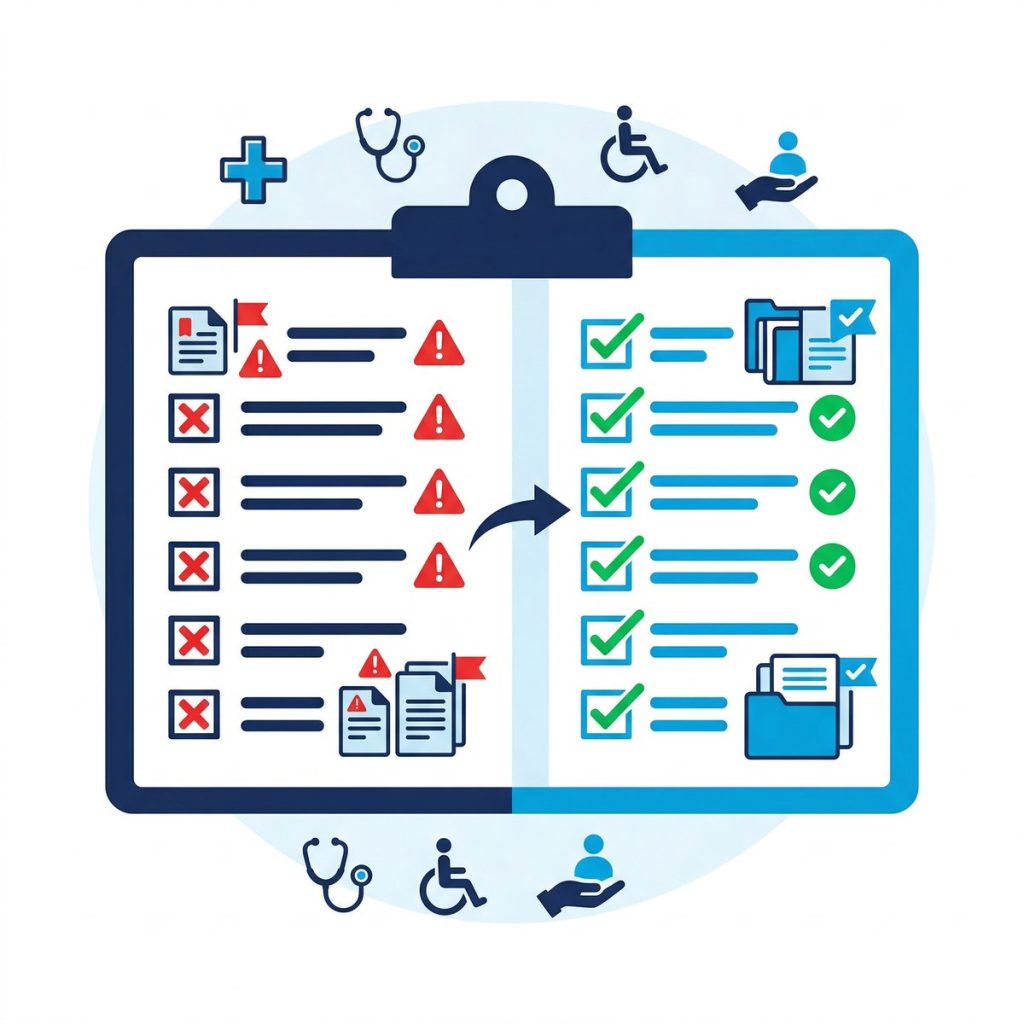
10 Common NDIS Practice Standards Compliance Failures (and How to Fix Them)
NDIS practice standards compliance failures are the number one reason registered providers fail audits and risk losing their registration. Yet most providers only discover their gaps when an auditor is already on-site. In this article, you will learn the 10 most common failures that trip up providers during certification and verification audits. More importantly, you will get clear, actionable fixes for each one so you can close compliance gaps before they become costly non-conformities.
What Are NDIS Practice Standards Compliance Failures?
NDIS practice standards compliance failures occur when a registered provider cannot demonstrate that their operations meet the requirements set out in the NDIS Practice Standards. Auditors document these gaps as non-conformities — formal findings that require a corrective action plan. Failures range from missing documentation to absent governance frameworks. Each failure carries a real risk to participants and to a provider’s registration status.
For a comprehensive overview of what the standards require, see our NDIS practice standards guide.
The 10 Most Common Practice Standards Audit Failures
The following failures appear repeatedly in audit findings across Australia. Understanding each one gives you a clear roadmap for building a genuinely compliant organisation.
1. Incomplete or Generic Documentation
What it is: Support plans, progress notes, and care records that use copy-pasted text, vague language, or lack participant-specific detail.
Why auditors flag it: The NDIS Practice Standards require that documentation reflects each participant’s individual needs, goals, and preferences. Generic records suggest that personalised supports are not being delivered as claimed.
How to fix it:
- Audit a sample of 10 participant records and identify where generic text appears.
- Create documentation templates that require worker input for each unique field.
- Train support workers on person-centred language and what “sufficient detail” looks like.
- Implement a supervisor sign-off process before notes are finalised.
2. Outdated Staff Training and Certification Records
What it is: Workers whose mandatory training — such as manual handling, medication management, or first aid — has expired or was never completed.
Why auditors flag it: Auditors request training registers during every audit. Expired certifications indicate that your workforce compliance system is not functioning. This is a common practice standards audit failure that directly puts participants at risk.
How to fix it:
- Build a centralised training register with expiry dates for every mandatory certification.
- Set automated reminders at 60 and 30 days before expiry.
- Assign a compliance officer to review the register monthly.
- Document completed refreshers immediately upon completion.
3. Weak Participant Engagement and Person-Centred Planning
What it is: Support plans that list goals without demonstrating that participants were actively involved in choosing them.
Why auditors flag it: The NDIS Practice Standards place participant autonomy at the centre of every service. If records do not show how a participant’s voice shaped their plan, auditors will raise a non-conformity. This failure contributes directly to NDIS non-conformity findings across the sector.
How to fix it:
- Include a dated signature or witnessed consent section in each support plan.
- Record how goals were discussed, including who attended planning meetings.
- Conduct annual plan reviews with the participant and document the outcome.
- Use accessible formats for participants with communication support needs.
4. Inadequate Service Agreements
What it is: Service agreements that are missing, unsigned, outdated, or do not cover required terms such as cancellation policies, complaints processes, and the participant’s rights.
Why auditors flag it: A valid, current service agreement is a baseline requirement for every NDIS registered provider. Missing or incomplete agreements signal poor governance and expose participants to unclear expectations.
How to fix it:
- Review your service agreement template against the NDIS Commission’s current requirements.
- Confirm every active participant has a signed, dated agreement on file.
- Schedule annual agreement reviews and document any changes.
- Store agreements in a secure, searchable system so auditors can access them quickly.
Our provider registration checklist includes a full list of service agreement requirements to cross-reference.
5. Poor Incident and Complaint Management
What it is: Incidents that were not recorded, not reported to the NDIS Commission within required timeframes, or where follow-up actions were not documented.
Why auditors flag it: The NDIS Quality and Safeguards Commission requires providers to have robust incident and complaint management systems. Gaps here represent a significant compliance gap fix priority because they directly affect participant safety.
How to fix it:
- Implement a dedicated incident management system with mandatory fields for classification and follow-up.
- Train all workers on what constitutes a reportable incident.
- Assign a nominated person responsible for lodging NDIS Commission notifications.
- Review all incidents monthly for systemic trends.
For more detail on what must be reported and when, read our NDIS reportable incidents guide and our full incident management guide.
6. Missing Risk Management Frameworks
What it is: No documented risk register, incomplete risk assessments for individual participants, or risk management policies that exist on paper but are not applied in practice.
Why auditors flag it: Risk management is a core module of the NDIS Practice Standards. Auditors look for evidence that risks are identified, assessed, and actively managed — not just listed in a policy document.
How to fix it:
- Create an organisational risk register and update it at least quarterly.
- Complete individual risk assessments for every participant at intake and after any significant change.
- Link risk management procedures to your incident reporting process.
- Ensure leadership reviews the risk register at board or management meetings.
7. Lack of Clear Audit Trail
What it is: Records that cannot demonstrate who did what, when, and why. This includes missing version histories, unsigned documents, and paper records with no timestamps.
Why auditors flag it: A clear audit trail is fundamental to demonstrating compliance. Without it, even well-run organisations cannot prove to auditors that their systems work. The absence of an audit trail is one of the most avoidable practice standards audit failures.
How to fix it:
- Shift from paper-based to digital record-keeping with automatic timestamps and user logs.
- Ensure every policy document includes a version number, date, and author.
- Record all participant interactions — including phone calls — with date, time, and staff name.
- Back up records regularly and restrict access to authorised personnel.
8. Non-Compliance with Worker Screening Requirements
What it is: Workers in risk-assessed roles who do not hold a valid NDIS Worker Screening Check, or whose check has expired without renewal.
Why auditors flag it: Worker screening is a legal requirement for registered providers. Employing a worker without a valid clearance in a risk-assessed role is a notifiable non-conformity — the most serious classification — because it represents a direct breach of legislation.
How to fix it:
- Map every role in your organisation against the risk-assessed role definition.
- Verify current clearance status for all workers before their start date.
- Track expiry dates and initiate renewal applications at least 60 days in advance.
- Maintain a live screening register accessible to your compliance team.
Review our detailed NDIS worker screening guide for role mapping templates and state-by-state requirements.
9. Inadequate Governance and Operational Management
What it is: A lack of clear organisational structure, undefined roles and responsibilities, or no evidence that leadership reviews compliance outcomes regularly.
Why auditors flag it: The Governance and Operational Management module of the NDIS Practice Standards requires providers to demonstrate active oversight. Auditors look for board minutes, management reports, and clearly documented accountability structures. Poor governance is a key driver of NDIS non-conformity findings at the organisational level.
How to fix it:
- Document your organisational chart with named roles and responsibilities.
- Hold regular governance meetings and minute them formally.
- Include compliance as a standing agenda item in leadership meetings.
- Ensure your governing body reviews audit findings and tracks corrective actions.
10. Failure to Conduct Regular Internal Audits
What it is: Providers that rely solely on their external certification audit to identify compliance gaps, rather than maintaining an ongoing internal audit program.
Why auditors flag it: The NDIS Practice Standards require providers to have quality management systems that include self-assessment and continuous improvement. Providers with no internal audit history have no mechanism for early detection of emerging compliance gaps. This is one of the most consequential compliance gap fixes a provider can make.
How to fix it:
- Schedule internal audits at least twice per year across all practice standards modules.
- Assign internal auditors who are independent of the areas they are reviewing.
- Document audit findings and corrective actions in a formal register.
- Use the NDIS Commission’s self-assessment tool as your baseline.
Use our NDIS compliance checklist as a starting point for your internal audit program.
How NDIS Non-Conformity Levels Work
When an auditor identifies an NDIS practice standards compliance failure, they classify it into one of three non-conformity levels. Understanding these levels helps you prioritise your response.
Minor non-conformity: The process or system exists, but it is not being implemented fully or consistently. For example, incident forms exist but workers are not completing all required fields. Minor findings carry a lower risk but still require a corrective action plan.
Major non-conformity: The required process or system is entirely absent, or the gap poses a higher risk to participant safety. For example, no incident reporting system exists at all. Major findings can prevent certification from being granted or renewed.
Notifiable non-conformity: The most serious classification. This occurs when there is a breach of legislation or a significant risk to the safety, health, or wellbeing of participants. For example, employing a worker without a valid NDIS Worker Screening Check. Notifiable findings are escalated to the NDIS Commission directly by the auditor.
The NDIS Provider Standards outline the legislative basis for these classifications in detail.
What Happens After a Practice Standards Audit Failure?
Receiving a non-conformity finding does not automatically mean you lose your registration. However, it triggers a formal process with strict timelines you must meet.
Within 7 days of a non-conformity finding, your organisation must submit a Corrective Action Plan (CAP) to the auditor. The CAP must detail the specific actions you will take, who is responsible, and the timeframes for completion.
Depending on the severity of the non-conformity, you will receive between 3 and 18 months to resolve the issue. Minor non-conformities typically require resolution within 3 months. Major and notifiable non-conformities require faster action and closer monitoring.
Furthermore, your auditor will conduct a follow-up assessment to verify that the corrective actions have been implemented effectively. Failure to address non-conformities within the agreed timeframe can result in conditions being placed on your registration or, in serious cases, registration being suspended or cancelled.
Additionally, all corrective action progress must be documented so you can provide evidence to your auditor at follow-up. A well-maintained audit trail — covered in failure 7 above — is therefore critical during this phase.
How Do You Prevent NDIS Practice Standards Compliance Failures?
Prevention requires building compliance into your daily operations rather than treating it as a separate activity. Conduct regular internal audits, maintain current documentation, invest in ongoing staff training, and use technology to automate compliance tracking. Review your systems against the practice standards at least every six months.
Specifically, the following compliance prevention checklist covers the most critical areas:
- Documentation: Conduct monthly spot checks on participant records for completeness and specificity.
- Staff training: Review the training register every month and act on any upcoming expiries.
- Worker screening: Verify clearance status before every new engagement in a risk-assessed role.
- Incident management: Test your reporting process quarterly with a mock incident scenario.
- Service agreements: Review all active agreements annually and update where required.
- Internal audits: Schedule two full internal audits per year and act on every finding.
- Governance: Include compliance as a standing agenda item at every leadership meeting.
- Risk management: Update participant risk assessments after any incident or significant change.
Moreover, providers that use purpose-built NDIS software can automate many of these checks, reducing the manual burden on compliance staff significantly.
What Is the Most Common Reason Providers Fail NDIS Audits?
The most common reason providers fail NDIS audits is incomplete or inconsistent documentation. When records do not clearly demonstrate that supports were delivered in a person-centred, safe, and compliant manner, auditors cannot verify conformance. Poor documentation affects nearly every practice standards module simultaneously.
However, documentation failures rarely exist in isolation. They are usually a symptom of deeper issues: workers who have not been adequately trained, systems that are too cumbersome to use correctly, or governance structures that do not prioritise quality assurance.
Consequently, fixing documentation alone without addressing the underlying systems will not prevent future practice standards audit failures. The most effective providers treat compliance as a culture, not a checklist. They invest in the right tools, train their teams continuously, and conduct honest self-assessments year-round.
In particular, the shift from paper-based to digital systems is one of the most impactful compliance gap fixes available to small and medium providers today. Digital systems create automatic audit trails, enforce mandatory fields, and send automated reminders — removing the human error that causes most documentation failures.
How Inficurex Helps You Avoid Practice Standards Failures
Inficurex is purpose-built NDIS software designed to eliminate the most common NDIS practice standards compliance failures before they reach your auditor. The platform centralises your compliance tracking so you can see at a glance which staff certifications are expiring, which participant records need updating, and which incidents require follow-up action.
Specifically, Inficurex provides structured incident management workflows that guide workers through correct reporting steps, reducing the risk of incomplete records. Additionally, the documentation module enforces participant-specific fields, preventing the generic entries that consistently trigger non-conformities.
Furthermore, Inficurex maintains a comprehensive audit trail across all activities — who did what, when, and why — so you can respond to auditor queries with confidence. For providers preparing for certification or verification audits, this level of visibility transforms compliance from a stressful event into a routine check-in.
Learn more about how Inficurex supports compliance at NDIS software for providers.
Frequently Asked Questions
What are NDIS practice standards?
NDIS practice standards are a set of quality requirements that all registered NDIS providers must meet. They cover areas including governance, participant rights, support delivery, incident management, and worker screening. The standards are enforced by the NDIS Quality and Safeguards Commission through regular certification and verification audits. Failure to meet them constitutes a non-conformity, which must be addressed through a corrective action plan.
How many practice standards modules are there?
The NDIS Practice Standards are divided into core and supplementary modules. All registered providers must meet the four core modules: rights and responsibilities, governance and operational management, the provision of supports, and the support provision environment. Supplementary modules apply to providers delivering higher-risk supports such as specialist behaviour support, early childhood, and high intensity daily personal activities.
What is a non-conformity in an NDIS audit?
A non-conformity is a formal finding by a registered auditor that a provider has failed to meet one or more NDIS Practice Standards requirements. Non-conformities are classified as minor, major, or notifiable depending on the severity of the gap and the risk to participants. Each non-conformity requires a corrective action plan submitted within seven days of the finding. Unresolved non-conformities can affect registration outcomes.
How long do I have to fix a non-conformity?
The timeframe depends on the severity of the non-conformity. Minor non-conformities typically must be resolved within three months. Major non-conformities may require action within a shorter period given their higher risk. Notifiable non-conformities involve immediate escalation to the NDIS Commission and require the fastest response. In all cases, you must submit a corrective action plan within seven days of the audit finding and track your progress formally.
Can I lose my NDIS registration for practice standards failures?
Yes. While a single minor non-conformity will not typically result in registration cancellation, repeated failures or unresolved major and notifiable non-conformities can lead to conditions on your registration, suspension, or cancellation. The NDIS Commission takes practice standards compliance seriously because failures directly affect participant safety. Providers that engage transparently with the corrective action process and resolve findings promptly are far less likely to face registration action.
What is a Corrective Action Plan?
A Corrective Action Plan (CAP) is a formal document that outlines the specific steps a provider will take to address a non-conformity finding. It must be submitted within seven days of receiving the finding from your auditor. The CAP should identify the root cause of the failure, the actions to be taken, the person responsible for each action, and the target completion date. Your auditor will assess the CAP for adequacy and follow up to verify implementation.
How often should I conduct internal audits?
At minimum, registered providers should conduct internal audits against the NDIS Practice Standards twice per year. However, higher-risk providers or those that have recently received non-conformity findings should audit more frequently. Internal audits should cover all relevant practice standards modules and produce a written report with findings and actions. Regular internal auditing is the most effective way to detect and close compliance gaps before an external audit occurs.
Do unregistered providers need to meet practice standards?
Unregistered providers are not subject to the same formal audit requirements as registered providers. However, they must still meet the NDIS Code of Conduct and can be investigated by the NDIS Commission for breaches. Unregistered providers can only deliver certain support types and cannot deliver higher-risk supports. If you are considering registration, reviewing the practice standards requirements early is strongly recommended. Our NDIS compliance checklist is a useful starting point.